
This is a book by Elizabeth Gilbert as a sequel to Eat, Pray, Love where she has a good relationship with the man Philippe, she met in Bali but both of them are afraid to commit to marriage after surviving divorces and everything that goes with it. However, they are faced with marriage or nothing if they are to live together in USA as he falls foul of the immigration authority. Ms. Gilbert investigates marriage through the years up to the present day and comes up with some interesting information and ideas about relationships.
She has a talk with a wife from the Hmong tribe in Vietnam and finds that each other has totally different concepts of marriage. The idea of marrying for love, being a good wife or husband is totally alien to the Hmong and many other people of the world either because they have an arranged marriage or they follow age old traditions of marriage where men and women have their place and duties and position in the tribe. So, a ‘happy marriage” is not something Hmong women think about. We however expect to have happiness from marriage. Are we asking too much of modern marriage?
In the early days BC, the fundamental working unit of society was the family. From the family came food, housing, education, religious guidance, medical care and importantly defense. But with the coming of Christianity there was a rejection of sexuality and marriage. When we speak today about “holy wedded matrimony” or the “sanctity of marriage” we should remember that for ten centuries Christianity did not see marriage as being either holy or sanctified. In fact, Christianity was hostile to marriage.
Later as the need for safety reduced and people lived in towns and villages marriage became the single most important business arrangement most people would ever make in their lives. Great wealthy families stabilized their fortunes through marriage. The big romantic white weddings didn’t come into being until the 19th century, before that people got married in their homes.
In the 13th century the church became involved in marriage. Divorce was banned, as it is still in the Philippines. In those days marriage made life more difficult for women. They lost legal rights of their own nor could they hold any personal property. In USA in certain states, as in apartheid South Africa, it was illegal to have an inter-racial marriage.
So, this transformation of marriage from a business deal to a badge of emotional affection has weakened considerably over time because marriages based on love are just as fragile as love itself. Divorce is the second most stressful event after death of a spouse.
Infatuation is the most perilous aspect of human desires. It leads to what psychologists call “intrusive thinking”, the state where you cannot concentrate on anything other than the object of your desire. The problem with infatuation is that it’s a mirage, a trick of the eye. Infatuation is not quite the same thing as love. Real, sane, mature love is not based on infatuation but on affection and respect.
It would appear that there are two types of men, those who have the vasopressin receptor gene and tend to be trustworthy and reliable sexual partners, sticking with one partner for decades, raising children and running stable households. Men who lack this gene are prone to dalliance and disloyalty, always needing to seek sexual variety elsewhere.
Married people sometimes form a friendship outside of matrimony but begin sharing intimacies and this leads to a physical relationship and if partners find out then it’s curtains to the marriage.
Some issues about marriage that need to be negotiated are discussed. Firstly, fidelity is a nonnegotiable condition of marriage. Housework and domestic chores need to be established as a shared duty. Do both partners want children and if so, how many? Are the couple compatible in bed and no problems with human sexuality. Partners often have different ideas about the managing of money issues and this needs to be sorted out as it can lead to major strife in the future. Does one draft a prenuptial agreement, well it’s probably not necessary if both parties have little money but if one partner has plenty and the other not much then it’s strongly advisable. If you think it’s difficult to talk about money when you’re blissfully in love, try talking about it later when you are disconsolate and angry and your love has died.
50% of marriages end in divorce in USA. This is more complicated than it looks once you break it down across certain demographics. The age of the couple at the time of their marriage seems to be the significant consideration. Eighteen-year-olds have something closer to 75% divorce rate. Age 25 seems to be the cut off point and the older you are the more chance you have of not ending up in the divorce court. Other factors of marital reliance are 1) the better educated you are the better off your marriage will be.2) Couple with young children at home report “more disenchantment “within their marriage. 3) People who live together before marriage have a slightly higher divorce rate than those who wait until marriage to cohabitate. 4) The less similar you and your partner are in terms of race, age, religion, ethnicity, cultural background and career the more likely you are to divorce.5) Social integration. The more tightly woven a couple are within a community of friends and family, the stronger their marriage will be. 6) Religiousness. The more religious a couple is the more likely they are to stay married. But only just. Born again Christians in USA have a divorce rate that is only 2% lower than their more Godless neighbors.
It would seem that up until the present time women have had a raw deal out of marriage, giving up the possibility of earning their own money and staying at home caring foe others and doing the chores. So why do so many women want to get married and have the full white wedding experience? It’s because they feel chosen, it’s their moment of glory. Today women have to decide whether they want children or not and if so how to balance a work life with looking after and bringing them up.
Despite all these men and women will forever get together as a couple, make vows to each other and somehow negotiate the tricky road of being partners. Elizabeth Gilbert did marry Philippe despite her misgivings. I googled and found that later they divorced and she then had a relationship with a woman.
Today I find that amongst young people there is no rush to get married, often they will have two or three relationships, sometimes live in, before tying the knot. Many women delay until their 30’s until having their first child. With my generation it was expected that one gets educated, married, have children, take on debt with buying a house and the rights cars and work for 40 years saving towards a retirement that often they don’t achieve due to an early death. There are alternatives and many younger people are discovering them.
Uncategorized
Happiness
Happiness. A Guide to developing Life’s most important skill by Matthieu Ricard.
The author is a French Buddhist monk and he explores different modes of happiness and then gives his ideas on how to achieve on going happiness in life. He defines happiness as a deep sense of flourishing that arises from an exceptionally healthy mind. This is not a mere pleasurable feeling, a fleeting emotion, or a mood, but an optimal state of being. Happiness is also a way of interpreting the world, since it may be difficult to change the world, it is always possible to change the way we look at it. To love oneself is to love life. It is essential to understand that we make ourselves happy in making others happy.
We look for happiness outside ourselves when it is basically an inner state of being. We forge bonds of friendship, start families, live in society, work to improve the material conditions of our existence – is that enough? Clearly not when we see the lives of unhappy rich movie stars.
The most common error is to confuse pleasure for happiness. Pleasure is a temporary phenomenon and most often centered on self. Living it up is how one is supposed to exist, a compulsory hyperactivity without any downtime. We are afraid to turn our gaze in upon ourselves. If we do take time to explore our inner world, it’s in the form of daydreams and imagination, dwelling on the past or fantasizing endlessly about the future.
The author urges us to spend time in meditation, to contemplate our lives and develop some inner peace.
“Suffering” is a part of life for most people. Either ill health, poverty, relationship problems, misfortune; all have to be dealt with at some time in life. If it is possible to relieve mental anguish by transforming one’s mind, how can this process be applied to physical suffering. There are certainly a number of ways to experience the same pain with more or less intensity.
The idea that a powerful ego is necessary to succeed in life undoubtedly stems from the confusion between attachment to our own image and the resolve to achieve our deepest aspirations. The reason for this is simple; self-importance is a target open to all sorts of mental projectiles – fear greed, repulsion – that perpetually destabilize it.
When the self-ceases to be the most important thing in the world we find it easier to focus our concern on others.
It is tempting to systematically pass the blame on to the world and other people. When we feel anxious, depressed, cranky, envious, or emotionally exhausted we’re quick to pass the buck to the outside world; tensions with colleagues at work, arguments with our spouse can be a source of upset. When we emerge from that moment of blindness during which we are completely in the grip of a strong emotion and our mind has been freed from its disruptive emotional burden, it is hard to believe that an emotion had dominated us to such an extent.
Never underestimate the power of the mind, which is capable of making vast worlds of hatred, desire, elation and sadness.
Some emotions make us flourish, others sap our well -being, others make us wither. Emotion covers any feeling that moves the mind, be it towards a harmful, a neutral or a positive thought. If an emotion strengthens our inner peace and seeks the good of others it is positive. If it shatters our serenity, deeply disturbs our mind and is intended to harm others then it is negative. Every incident of aggression and jealousy represents a setback in our quest for serenity and happiness.
Since altruistic love acts as a direct antidote to hatred the more, we develop it the more the desire to harm will wither and finally disappear. Anger can be neutralized by patience.
Few of us would regret the years it takes to complete an education or master a crucial skill. So why complain about the perseverance needed to become a well-balanced and truly compassionate human being.
As natural as it is desire degenerates into a mental toxin as soon it becomes craving, an obsession or an unmitigated attachment. Generally, once mental images linked to a desire begin to build up in the mind, one either satisfies the desire or surpresses it. The repeated reinforcement of mental images leads to addiction and dependency, mental and physical. The experience of desire is felt more like servitude than pleasure. We have lost our freedom. The obsessive desire that often accompanies passionate love can degrade affection, tenderness and the joy of appreciating and sharing the life of another.
Altruistic love is the joy of sharing life with those around us, our friends, our lovers and companions, our wife or husband, and of contributing to their happiness. We love them for who they are and not through the distortion of self-centeredness.
Of all the mental poisons hatred is the most toxic. It is one of the chief causes of unhappiness and the driving force of all violence, all genocide, all assaults on human dignity. As Gandhi said ” If we practice an eye for an eye and a tooth for a tooth, soon the whole world will be blind and toothless.” To react spontaneously with anger and violence when harm has been inflicted is sometimes considered heroic, but in truth those who remain free from hatred display much greater courage.
We are envious of other peoples” happiness and certainly not of their unhappiness. We should try to set aside the mental images that torture us and the obsessiveness that makes us dream of cruel reprisals against the usurper of whom we are jealous.
Inner freedom is above all freedom from the dictatorship of “me “and “mine”, of the ego that clashes with whatever it dislikes and seeks desperately to appropriate whatever it covets.
Our life is frittered away by detail…. Simplify, simplify. Renunciation involves simplifying our acts, our speech, and our thoughts to rid ourselves of the superfluous. Three main conclusions emerge from studies. First, outward conditions such as wealth, education, social status, hobbies,sex,age,ethnicity, and so on account for no more than 10-
15% of the variable satisfaction quotient. Second, we seem to have a genetic predisposition to being happy or unhappy – about 25% of our potential for happiness appears to be determined by genes. Third we can exert considerable influence on our experience of happiness and unhappiness through the way we live and think, how we perceive life’s events and how we react to them.
The sense of happiness is higher in countries that ensure their inhabitant’s basic resources, greater security, autonomy, and freedom, as well as sufficient educational opportunities and access to information.
Happiness rises with social involvement and participation in volunteer organizations, the practice of sports or music, and membership in leisure clubs.
People who are married or cohabitating are significantly happier than singles, widows and widowers or the divorced or separated living alone.
Happiness tends to be greater among those who have paying work. Death rates and incidences of illness, depression, suicide and alcoholism are notably higher among the unemployed. Retirement makes life not less satisfying but rather more so. Happiness is more pronounced among highly energetic people in good condition. It does not seem to be linked to climate.
Leisure activities enhance satisfaction. Vacations have a positive effect on well-being. TV watching leads only to a minimal increase in well-being.
Money does not buy happiness. For those who lack the basic means of subsistence and for whom money becomes a question of survival, obtaining more wealth brings a legitimate sense of satisfaction. However, it appears clearly that beyond a relatively low threshold of wealth, the level of satisfaction remains unchanged even as income continues to rise. One of the main sources of peoples’ discontent comes from comparing themselves with others in the family, at their work place and among their acquaintances.
As a general statement people who have a happy disposition live longer.
There is an undeniable correlation between altruism and happiness, determining that those who believe themselves to be happiest are also the most altruistic.
In a study optimists live 19% longer on average than pessimists. An optimist is somebody who considers his problems to be temporary, controllable and linked to a specific situation. The sense of insecurity that afflicts so many people today is closely tied to pessimism.
We should put our time to good use, not just waste it. Boredom is the fate of those who rely entirely on distraction.
The “state of flow “is where one becomes completely absorbed in the task being carried out whether it is making a painting, playing football or concentrating on a teaching; to the exclusion of all other thoughts. Doing this on a regular basis contributes to one’s feeling of wellbeing. This is not dissimilar to meditation.
Everybody is interested in happiness. But who is interested in enlightenment? And yet ultimate well being comes from fully eliminating delusion. Enlightenment is the state of ultimate freedom that comes with a perfect knowledge of the nature of the mind and of the world of phenomena.
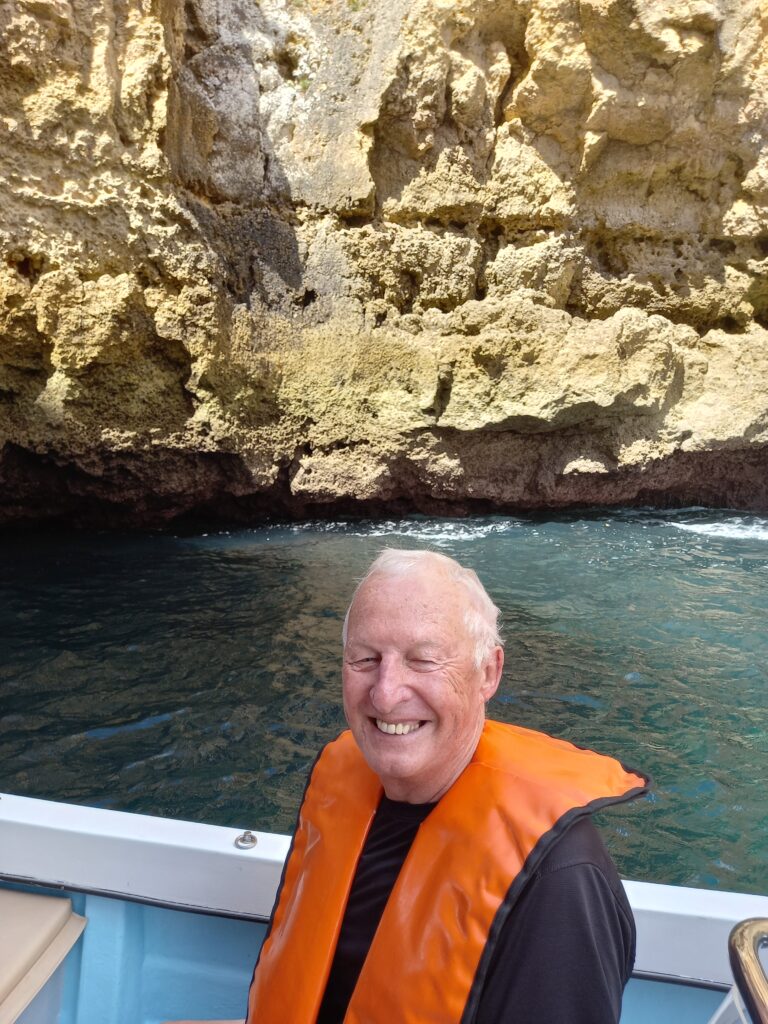
Portugal 2022
Travelling from Spain to Portugal is no problem , the bus just crosses the border without stopping . I met Georgie, an Australian traveler and two elderly Swiss also travelling around by bus. I booked for 5 nights in Porto to give me a chance to recoup. I’m finding travelling stressful in this time of Covid and crowded airports There were a number of Ukrainian refugees at the bus breakfast stop, it breaks your heart to see them. If I think I become stressed what about their situation and future.
What strikes me is how the Europeans treasure their heritage; have clean modern fast public transport, obey the rules of the road and use the city centers. In SA they are destroying everything.
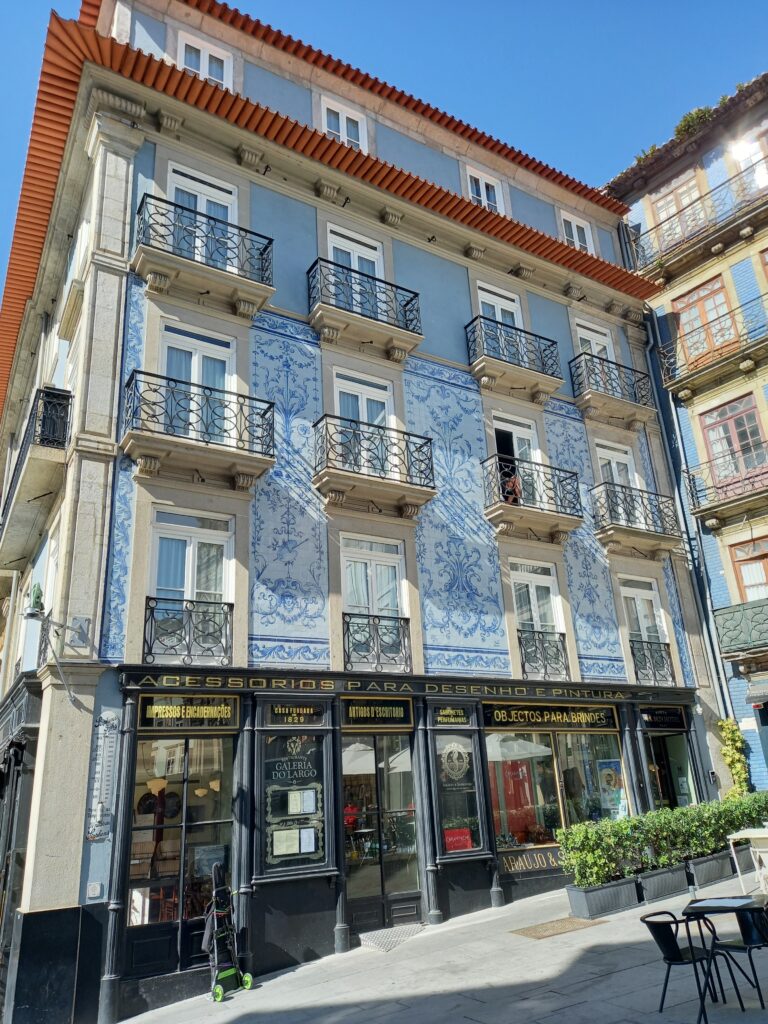
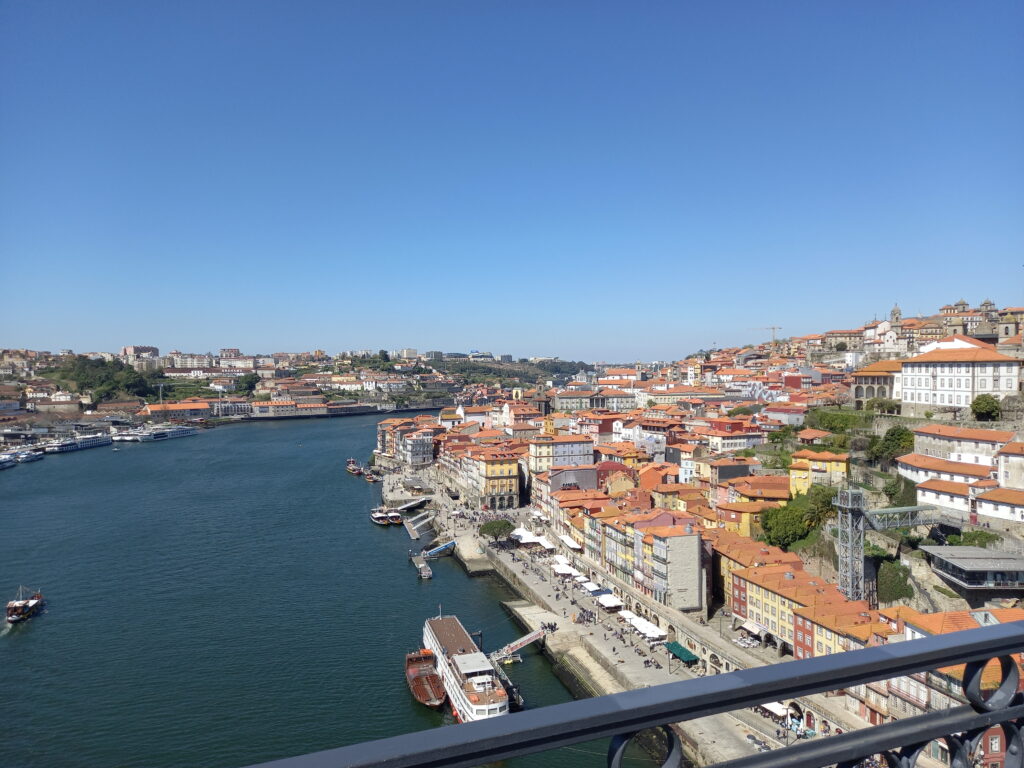
Porto is a charming city built alongside the river. I walked up and down the cobbled hills and had a coffee by the river. There are plenty of back streets to explore and blue tiled buildings including the train station. The cathedrals are a bit more rough and ready and not so spectacular as Spain
I went by train to Aveiro and found it a mish mash of old town; a much vaunted “Venice “with a few gondolas floating about in the canals. The old town is delightful and I ate sitting outside. So far, I have found the food to be superior to Spain, healthier and not just a preponderance of bread.
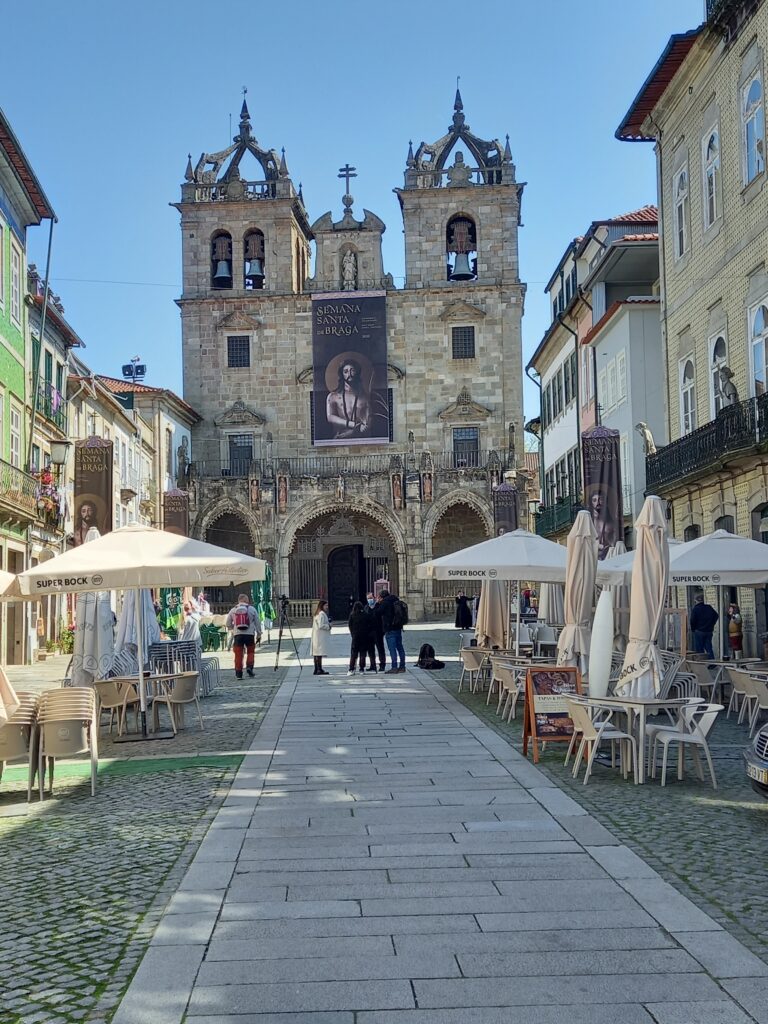
The next day I visited Braga by train, the third largest city in Portugal. This is a real gem, pedestrianized city center with plenty of cafes, cathedrals, houses of interest. One could spend many days exploring the history and architecture of the town. I could certainly live there.
In Porto I took a hop on hop off bus along the coast and watched the surfers and plenty of people exercising, running, walking, biking. The old port wine warehouses have been converted into wine tasting and cafes by the river. Rangers were playing Braga and a number of supporters were staying in the hotel, I only realized they were Scots after a while as their accent was untranslatable Why anyone would travel that distance to watch a second-rate team is incomprehensible to me. All these supporters looked like giant retards let out from a lunatic asylum for the day.
My train to Lisbon was more an express with lots of stops than a high-speed bullet train, but very affordable and packed. Getting on and off was a bit like a rugby scrum but with bags.
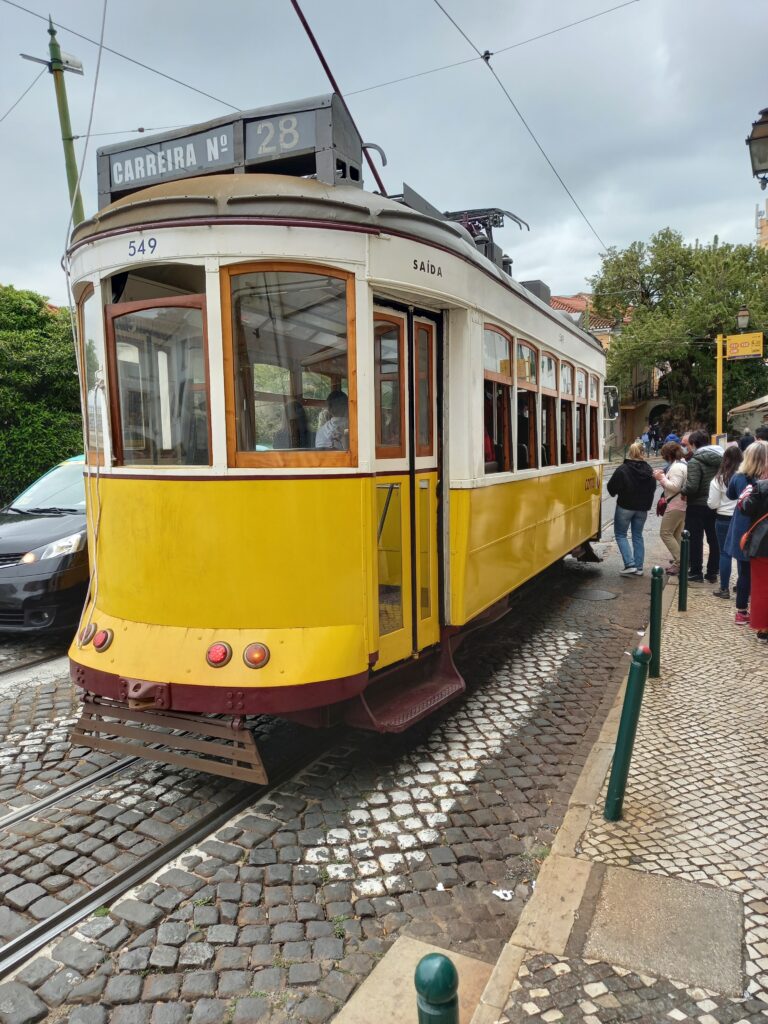
Lisbon is a somewhat bigger version of Porto and very touristy. I sometimes think these places are a theme park laid out for tourists. I spent the first day going up and down the hills to the castle, there were huge queues here to enter so I gave it a miss. On I went through the narrow lanes, stopped at the Thieves Market where I bought a wallet and lost my umbrella. The next day I caught a hop on, hop off bus through the more modern city to the extensive water front, then up on the old tram through the narrow lanes. This was good fun , the old tram making its way up the hill through the narrow lanes. . We met a car coming down which had to back up the hill.
I then caught a train to Sintra, packed with tourists. Again I felt that this was more a theme park than anywhere else with tour buses, tuk tuks , guides meeting the train. It was a bun fight. I started to climb up to the castle on the top , reached the walls but realized that I would have to wind my way round the hill to the entrance and the hordes. But I got away from the crowds. I just found everything a bit too much and jumped on a train back home.
The longer you stay in a city the more you like it and like all the others Lisbon has grown on me.
When you travel I think you should have a purpose. Joining the throngs ambling around is a waste of time. Either study aspects of cities, i.e., architecture, art, language or do a trek, cycle tour. In this case we will now look for some property to buy.
Patrick and Carol arrived and I met them at the airport. We moved to an Airbnb; it was nice to have space to move around in instead of living in a cupboard. On our first day we went into Lisbon by tube and did the other half of the Hop on Hop off bus. This was through the newer part of Lisbon and we strolled along the river next to a huge convention center with restaurants, hotels. We then took a tram, the wrong one, which clanked its way through tiny streets. We stopped next to a café and I could have reached out and drank a girl’s wine from her table through the open window. We passed parked cars with maybe 1 inch to spare. The tram dropped us off in a suburb, using Google maps we walked to the nearest Metro station and then home.
This brings to an end my 6 days in Lisbon. An intriguing city. The next time I come I will explore some of the museums such as the tile museum.
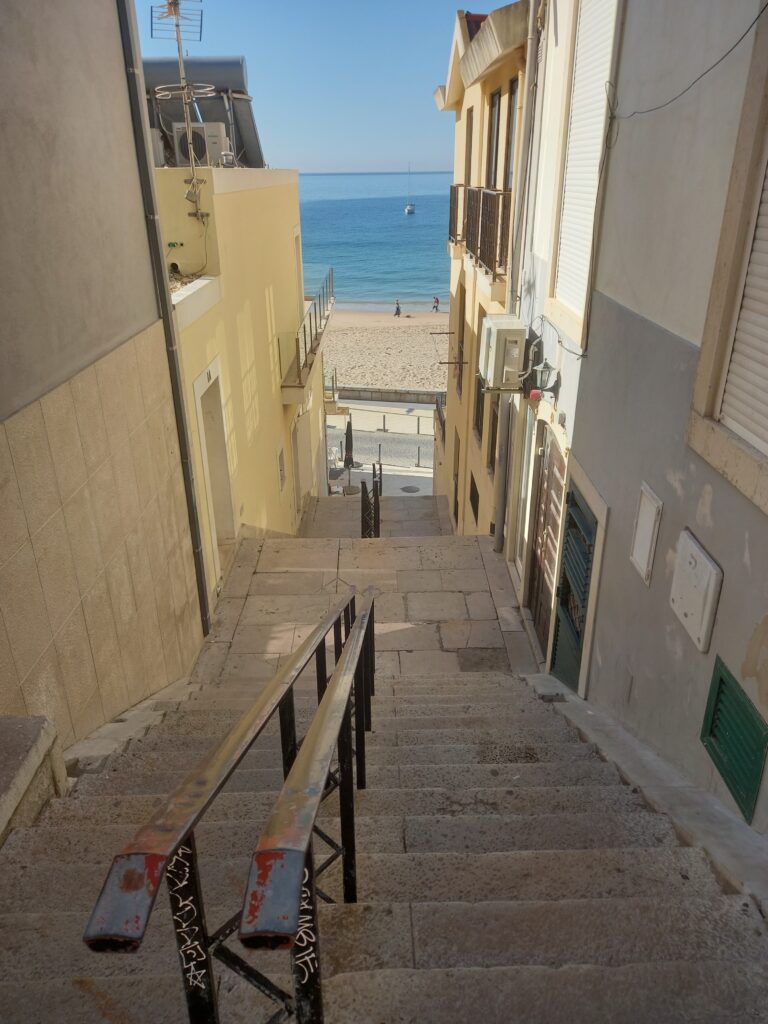
We took an Uber, about 40 minutes, to Sesimbra , on the coast. We stayed in the old town, a stone’s throw from the beach. Our Airbnb is so small you can’t swing a cat around but we manage. It’s a small alleyway with a flat above us, down the street is a tiny grocery store. Washing is hung out in the street. The beach is beautiful and the weather perfect maximum 21C. We walked to the yacht mole, had a pizza dinner by the sea, and the next day walked up the hill to the castle with stunning views over the bay.
This was Easter weekend and very busy, on Sunday we had a fish dinner sitting outside with a wonderful view of the sea. As well we took a walk to the fishing harbor.
Impressions of Portuguese people are good; friendly, helpful and many speak English. There are many shops selling delicious cakes, bread . We look out for lunch time specials in the restaurants.
Another bus trip to Azeitao , an old village in the wine country , where we went to Bacalhoa wine farm and had a tour around the old palace there with a wine tasting . It’s a beautiful place owned by Joe Berardo who had originated mine dump mining for gold in SA. We also met three SA women, one of whom has immigrated to Cascais which is North of Lisbon.
When it comes to property its quite clear that buying something by the sea is expensive. We took a hike up the hill to obtain a view over the bay through the rather ugly developments up the hill. 60M2 is a normal size for an apartment. In fact, everything is on a small scale in Sesimbra, the small supermarkets are tiny and one tends to be doing waltzes around other shoppers and workers stacking shelves. The people are also quite small, we saw a tall blonde girl in a café and knew she was either from Scandinavia, Germany or Holland, she was from the latter.
We went to the market in Setabal, a feast of colorful fruit and vegetables, meat, cakes, and most of all fish. We took a walk around the old town with its alleyways and shops. All the towns we have been in are a mixture of spruced up properties and ruins waiting to be done up, a huge contrast often next to each other.
Our next move was to St Luzia , a small town in the Algarve. We accomplished this by Uber to the nearest railway station, a train to Faro and then an old two coach train to Tavira. We talked to a young lady at the station café who had lived a lot of her life in UK and then moved back to Portugal. She said the economy in Portugal was weak and the minimum wage was 600 Euros per month and rentals were Euro 600/month. When we arrived at our Air BnB we had a snack at the nearby café and had a chat with the owner who had also lived in UK for a number of years. We are staying in a beautiful apartment; I think we are the only ones staying in the block but I guess it becomes mayhem in August. But this is luxury compared to where we stayed in Sesimbra.
And then Covid struck me down, at first, I thought it was flu but it became a bit too severe for that. I count myself lucky in that I didn’t catch it in Sesimbre where we were all on top of each other, here there are 2 bedrooms,2 bathrooms, and plenty of space. Covid was pretty painful for me, sore throat, and being also overwhelmed by streaming mucus.
But after a week I was almost back to normal and able to appreciate our surroundings. In this part of the country, you are next to the sea but not, there is a channel through a marsh with the beach on the other side. It can be reached by walking across a bridge or a small train or a ferry boat. Otherwise Santa Cruz is 3 kms from Tavira and consists of a fishing harbor for octopus , small attractive narrow streets and apartment developments. I have the feeling we have missed the boat so far as cheaper properties are concerned in this area.
After Covid we took a walk to Tavira which we found to have many tourists in the center with a mix of older and newer buildings.
We do the most of our shopping at a local supermacado , cramped with shelves packed with stuff. It’s a different lifestyle in Portugal, small, cramped dark apartments, guys drinking tiny espressos or something stronger in cafes and restaurants.
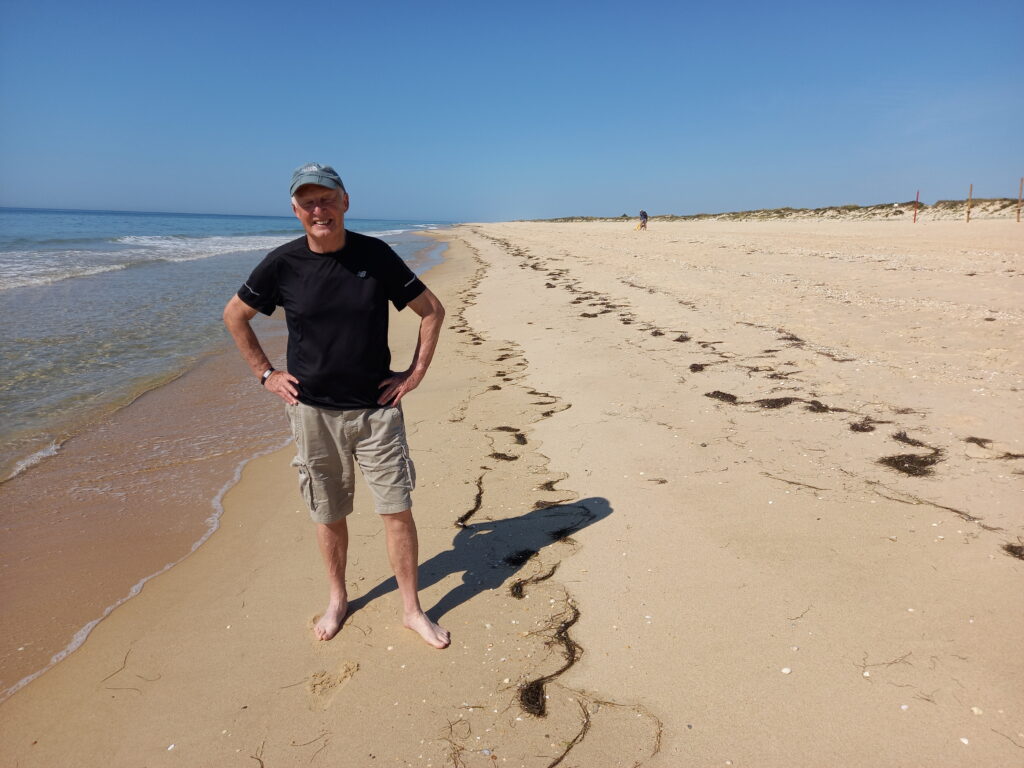
We took a ferry to the Island of Tavira and walked along the beautiful empty beach and had a nice coffee. We’ve also walked to the local Aldi store through the countryside with vines and flowers. The weather is getting hotter by the day.
At this time, I am thinking hard about my life and what’s to follow. Whether I live in Durban or Portugal is immaterial. It’s filling the time, feeling useful, fulfilled and content. On one of my walks I passed through an estate of beautiful houses with a center piece of a hotel , café , pool and sitting area. What a beautiful place to live.
At this time of year the majority of people are grey haired; many retired people in Europe are well off; good pensions, secure financially. Most people come for the sun, peg themselves out on the beach or by the pool and burn themselves a bright red tomato color. I can understand that people from dark ,rainy ,cloudy countries crave the sunshine and getting a good tan . I can see their reaction to the sunshine and the heat; they love it. As we stay in the Algarve it’s getting progressively hotter ; so now I take a walk in the morning and the rest of the time chill out. We saw an old man foraging for herbs in the grass, fields of wild flowers, pigs and sheep. I must say that it’s somewhat boring staying here because it’s off season but it’s helping to clarify my mind for the future. Currently I believe I will keep my base in SA and continue to travel. Why bury myself in Portugal? . What does work for me with travelling is mindfulness, I live each day as it comes.
We took a train to Vila Real de Santo Antonio, a small picturesque town on the river with Spain on the other side. It has an extensive yacht harbor and a well laid out old town. Another good place to retire.
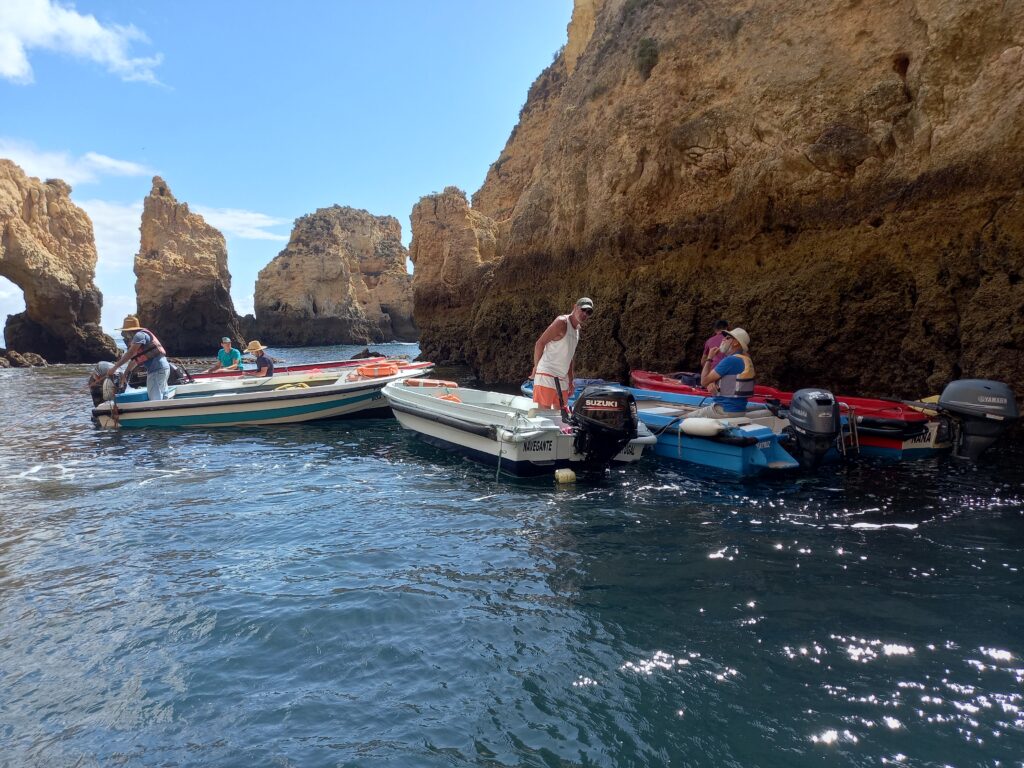
The other two moved North for a year’s rental and I caught the train to Lagos. This is a bigger town with an old center, a harbor, a long beach and other smaller beaches hidden amongst the cliffs and crags. Its rather touristy but there’s lots more to do than Tavira. I’m staying in a house with a pool and kitchen which is shared with Chileans, a Danish lady who walked from Lisbon, 300 kms, and guys from Holland and Ireland who are digital nomads. There is an alternative life style and they are living it. This stretch of coast has these weirdly shaped sandstone cliffs and I first walked them and then the next day took a boat and went through little arches into grottos and caves. It is a truly spectacular place with plunging drop holes in the ground and in between hidden beaches.
I took a bike ride to Luz and Burgau , small towns along the coast. All went well except it started to get hot on the way back and I find I get burned with the strong sun. The beaches are superb all along the coast. I also went by bus to Sagres which is the furthest town in the West by the Cape of St Vincent, soaring cliffs, turquoise water, a constant wind and lots of surf shops. The town has an end of the world feel and the scenery is similar to the Cape of Good Hope. The bus takes its time , taking loops off the main road into small villages , sometimes even doubling back on itself. At one village there was a hippy looking girl with a rusty old bike, an open suitcase and lots of packets, shopping bags, rucksacks and the like. She opened the bus luggage compartment to put the bike in but the driver stopped her and wouldn’t allow her to board.
Now I’m puzzled as to how people can lie on a beach for hours in uncomfortable heat turning themselves into lobsters and running the risk of future skin cancer . Most of them have awful bodies anyway
In the meantime, travelling by air to and from UK has become very stressful with many cancelled flights and long queues. Sure enough my Wizzair flight to London was cancelled at midnight and I spent two hours on my phone finding an alternative flight, at high extra cost.
My time in Spain and Portugal has come to an end. The original idea was to look for a place to live so what has changed? Although Portugal lives up to its reputation, good weather, friendly people, reasonable cost of living, the cost of housing in the coastal areas and major cities is prohibitive. The alternative is to live up in the North in a housing area , most of which are rather sterile and ugly. What would I do with myself each and every day cut off from friends and family? Although the health service is reputed to be a good one, at home I have a GP who knows me with all of my notes, a heart specialist and a private service which I can afford. So if Simon, my son, wishes to buy a property for his future in Spain or Portugal then I could help him financially and to locate somewhere.
Spain 2022
I flew to Barcelona by EasyJet from London Gatwick , an easy seamless experience. I then walked the wrong way for miles lugging my case before realizing my mistake on Google maps and turning around and finding my hotel.
On my first day in Barcelona, I walked 16K to the Gothic Quarter and back, wonderful narrow alleyways and then the Picasso Museum, mainly his early work. Barcelona Cathedral is majestic; Impressions of Barcelona are good; there is some wonderful architecture. Youngsters zoom about
on electric scooters, bike lanes on major roads. There doesn’t seem to be a lot of traffic jams, probably due to the good public transport.
I spent the day with Janet, an English teacher who has been living in Barcelona for some time. We walked up to Montjuic , a hill overlooking the city with wonderful views. The Olympic stadiums and diving centers are up here. Janet told me Spain is a beau acratic nightmare. She has a good life in Barcelona; a nice flat that she shares; lots to do, she likes partying despite her age, friends, the Montjuic on her doorstep to exercise in.
The hours here are completely different. Work starts at 09.00, followed by a big lunch at 2.00.and then back to work at 4.00pm followed by dinner at 9pm.
Everybody picks me out as an Englishman before I speak a word.
I found a South African bar; the lady serving is Norwegian married to a South African.
I visited the Sagrada Familia, a huge soaring unfinished cathedral built by Gaudi. It’s a remarkable building but I can’t help thinking that it has some trashy features on the exterior but the interior is amazing.
I had trouble with the metro ticket so walked home and a bird proceeded to shit all over me from a dizzy height. A kindly fellow helped me clean up.
So, the next day I moved on by high-speed train to Madrid and arrived in pouring rain with another detour courtesy of Google maps. I probably didn’t type in the name of the hotel correctly or didn’t differentiate between driving and walking.
Madrid must be one of the world’s most wonderful cities, a vibrant, moving, elegant place. It has huge museums, wide boulevards, palaces, splendid architecture with squares and lots of bars and restaurants. And a lot of walking.
I met Olie my grandson and Natalia in the Park Returo , he’s a lovely boy and I feel quite sad that he can’t be a part of our lives on an ongoing basis.
I visited the Royal Palace, walked the streets and squares. The police are everywhere; people demonstrating and police watching them carefully. Cycling, as you would expect is big and people zooming around on electric scooters. I bought a book at a book stall and came across old guys with stamps and coins in the square. On Sundays the people congregate in the center of the city and eat a meal or drink a beer.
So on to Toledo with a short 30-minute train ride. The old city sits on the top of a hill. It has two large cathedrals, lots of smaller churches and narrow alleyways linking them up. So I spent my time wandering around slowly, recuperating from the stresses of Madrid and Barca. I’m not so impressed with Spanish food, lots of bread, ham and cheese but the architecture takes your breath away.
I climbed the tower of one of the cathedrals despite warnings to people with cardio problems vertigo, senior citizens etc. Toledo is just wonderful, it has such a mish mash of architectural styles and all encompassed in narrow alleyways.
From there on to Segovia by train via Madrid. The train left from a different station which meant catching a taxi from one station to another. There are thousands of taxis in Barcelona and Madrid but on arrival to Segovia there were none. A bus was stood there with Centro on it so I hopped on and then walked up the hill to my guest house. The place is down a narrow alleyway and dark inside with no one around. I rang the number and a lady appeared who checked me in. (sort of). The next issue is laundry and I traipsed around town until I found one which was staffed and friendly.
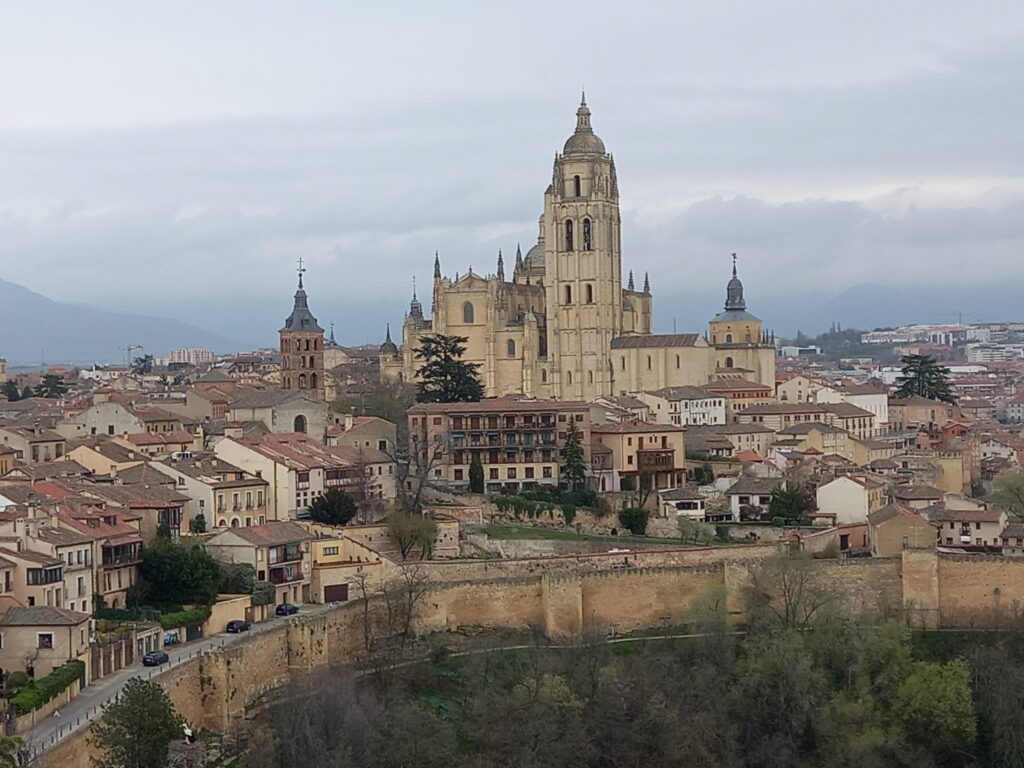
Segovia is cold with snow on the hills but again a really lovely place. I went to the Alkazar de Segovia, the Royal castle built on an outcrop high above the valley. I climbed the tower and huffed and puffed a bit. I walked the old town and generally sorted myself out with future bookings and transport.
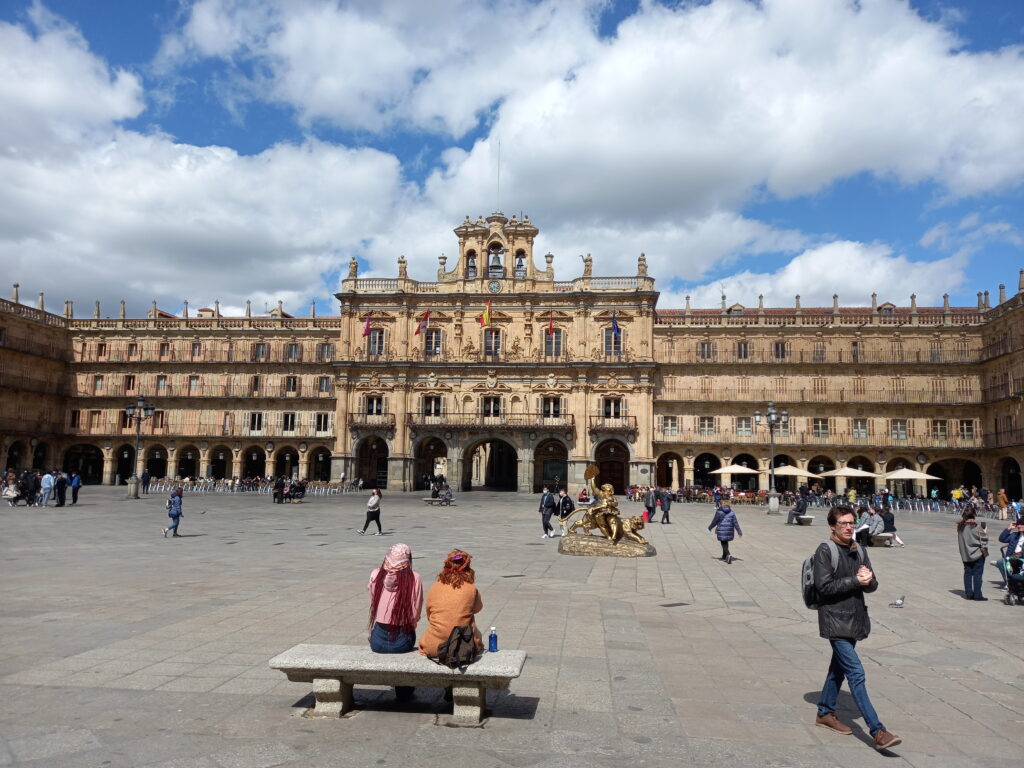
From there another train ride to Salamanca, past hills covered with snow; this time I’m staying in a cupboard next to a main road. Once again, these Spanish cities never cease to amaze with their architecture, soaring pillars, stain glass windows, tombs, paintings. When I entered the cathedral a lady told me that this was the new cathedral which was built from the 16th to the 18th century . So I asked her “when was the old cathedral built?” Mattter of factly she told me “ in the 10th century”. The Plaza Major is a huge square teeming with people eating and drinking. But there are quiet gardens next to the cathedral to sit and ponder. But it’s cold to linger or sit outside. Many restaurants don’t even open in the evening until 8.30 pm
There’s a strong similarity between Salamanca, Toledo and Segovia; all are built on hills and their cathedrals forts and monasteries dominate the countryside. The centers are all pedestrian ways with narrow alleyways leading to squares, some like Plaza Major in Salamanca are huge with masses of people sitting outside enjoying a drink.
I walked to the bus station early on Sunday morning with the temperature -3C and caught the bus with one change to Porto.
Spain is much more than crowded beaches and summer vacations. There are still more fascinating cities and villages to visit in the future.



South African Road Trip 2




This trip was the result of an urge to get away and think about the future following the worst episode that I have experienced since being in South Africa. Zuma was jailed and the Zulu people decided to go on the rampage. They looted stores, burnt down warehouses, destroyed trucks, schools and clinics in an orgy of destruction whilst the police stood by dumbstruck. For a number of days, I was confined to my apartment, men took to the streets armed to patrol and defend their families and properties. Shops were closed, then opened with a minimum of stock and people queued for hours to get basic foodstuffs. Some farmers made deliveries of basics. Eventually things returned to a semblance of order but there is always the lingering thought that this can reoccur.
So, Patrick and Carol intend to have a look at Spain and Portugal to live in 2022 and I have decided to go with them. This trip was to discuss and plan as well as seeing some more of South Africa.
I first had to drive 700 kilometers through the Transkei to Port Alfred with snow on the distant peaks; as always in South African towns lines of people were queuing trying to access their benefit money from post offices and banks. The ANC is now talking about a Universal Grant as currently we have thirty five percent of the working population unemployed. Of a population of 60 million, 18 million receive social grants, almost a third. There is a declining base of taxpayers, 1.6 million are shouldering the bulk of all the income tax paid. This is no way to run a country.
The approach to Cape St Francis is via a squatter camp, shanty settlements with long drop toilets next to the road and pigs ferreting amongst the rubbish. This is in contrast to the splendid houses built next to the sea many of which are empty as holiday homes for people in Johannesburg and Cape Town. The village is clustered around the lighthouse and walking paths either along the beach or in the fynbos with the rocky headland giving us sights of breaching whales and dolphins swimming through the breakers. We climbed up the spiral staircase to the top of the lighthouse and needed a strong coffee in the pleasant restaurant after the vertigo inducing views at the top.
Nearby is a development built around canals and we visited friends doing a complete refurbishment of their house. Building activity was going strongly as people move from Johannesburg, Cape Town and Durban to quieter towns having discovered during Covid that they can carry out their business remotely.
Nearby St Francis Port is a pleasant mixture of apartments and working harbor leisure craft and fishing boats catching squid, hake and pilchard. We had a cup of tea with friends who told us that Cape clawless otters are seen regularly together with good bird watching.
Jeffries Bays is made famous by Super Tubes, a world-famous surfing break and is now a straggling town with plenty of surf shops. It’s unrecognizable from the village that I last visited thirty years ago on a surfing safari with my sons.
Rain was forecasted for the next so we decided to change our plans and move inland to the dry Karoo until it cleared.
We drove through the Langkloof valley with orchards of apples and pears below the high mountains and stopped for a coffee at the “Sweaty Dutchman café” in Kareedouw, a small picturesque village. He was sweating inside together with his clientele and greeted us all with a handshake. Carol, as per normal, engaged the locals in a discussion about the state of the nation. We eventually carried on the 300 kms to Oudtshoorn along often dead straight deserted roads past orchards and vineyards. On passing from the Eastern to the Western Cape it’s immediately noticeable that the road surface improves and the lay byes are neat and clean.
Oudtshoorn is a town built around ostrich farming and its history. We’ve all seen the sights before so this was more or less a stopover. We stayed in a beautiful renovated cottage and the owner told us that she had taken a leap of faith after the death of her husband and moved here from Cape Town and derived her income from a number of sources as well as the rental from her cottage.
We carried on to Beaufort West through the spectacular Meiringspoort , a winding 16 km pass through the soaring Swartberg mountains. In this area the mountains are” folded “; you can see the volcanic plate movements in layers. Once again it was evident to see the neat well-kept parking with braii areas and toilets.
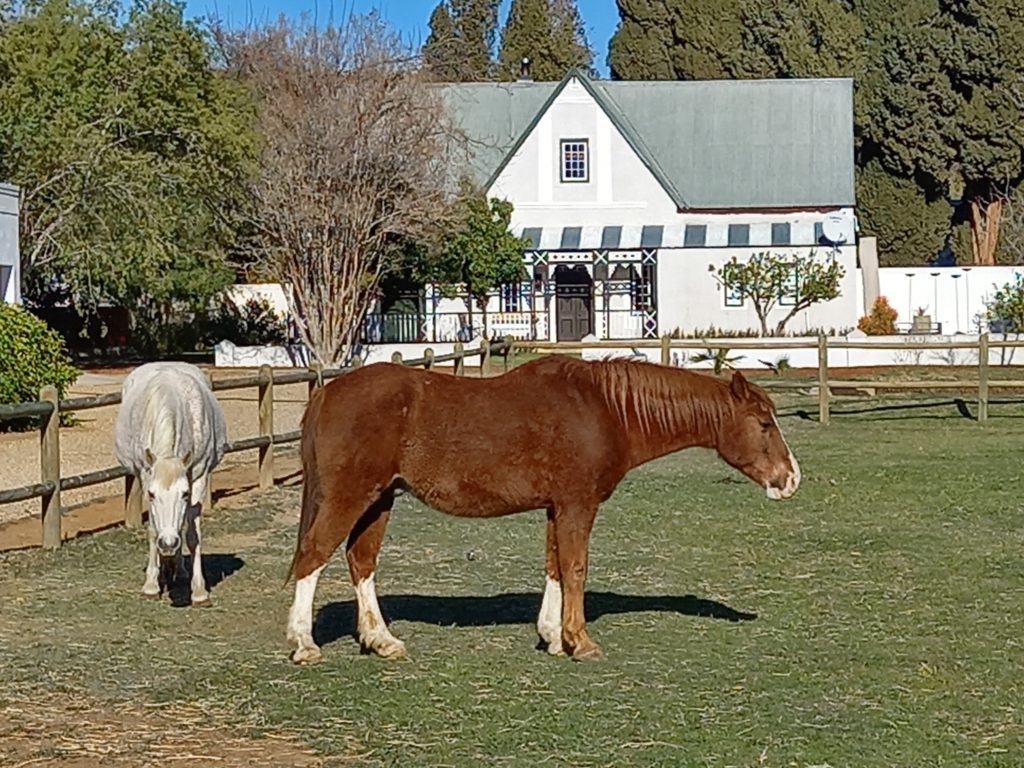
The N1 highway from Cape Town goes smack through the middle of Beaufort West; at first, we thought our apartment was in the middle of some warehouses but in fact we found it down a small lane directly off the main road; an old Cape Dutch cottage with a garden like an oasis from the growling trucks passing by. The owner and his wife are sheep farmers in the Northern Cape; drought has made farming difficult so they are investing in property, renovating the old historic buildings and letting them out for travelers.
The Karoo National Park is an arid but beautiful mountainous reserve; we didn’t see many animals but that’s not surprising as the grassland is so sparse. We climbed up the Klipspringer Pass and talked to a family who had been photobombed the previous day by a black rhino. Unfortunately, we didn’t have a 4×4 because the trails must be awesome.
We travelled on to Prince Albert; a small village in the middle of nowhere with beautifully renovated Cape Dutch houses. The owner of our cottage told us that the property market has taken off during the Covid 19 epidemic as people from the cities realize that they can carry out their business from anywhere. Her husband is a builder and their large garden had lemon and olive trees and veggies grown with hydroponics. The town is fed from an aquifer system from the river running from the Swartberg mountains.
We travelled up the Swartberg pass, a 24kilometer gravel road built by Thomas Baines which at times reaches 1 in 8 with hairpins and passing points for on coming traffic. At the bottom I looked up and saw retaining walls up the hill; I thought these were to stop avalanches until I saw a car driving next to one. I didn’t think we would make it but a steady pace in 1st gear was fine. At the top the we were in the clouds and the wind was howling.
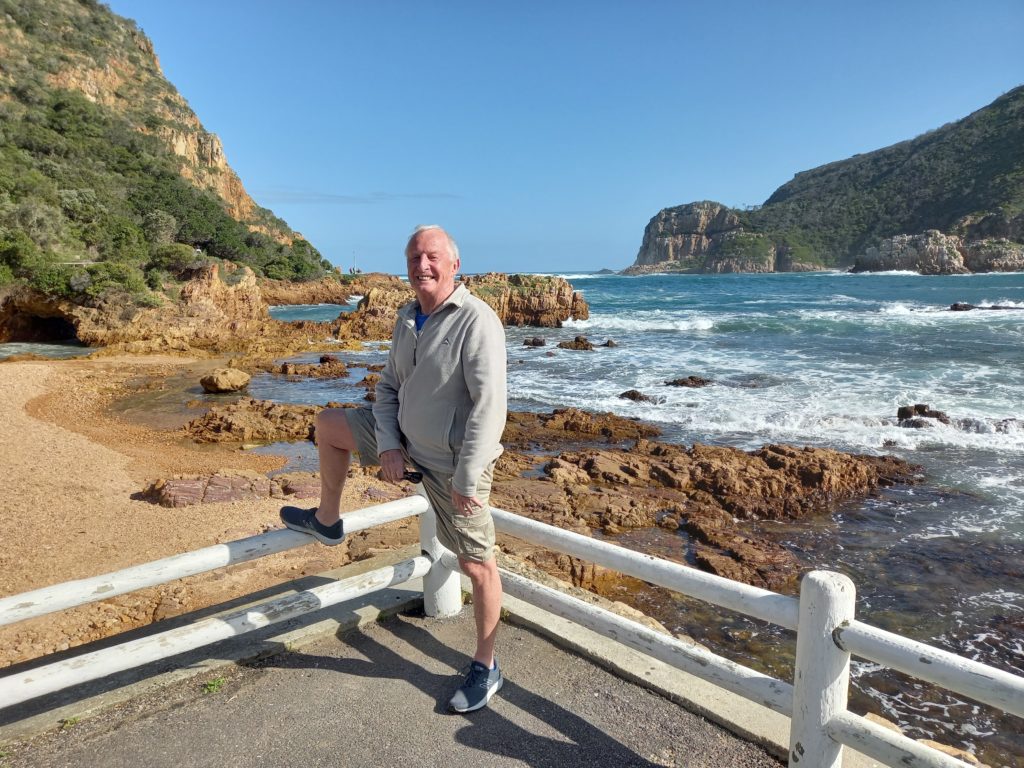
We descended down through Oudtshoorn and George and stayed two nights in Knysna. This is a well-known South African resort with a small rough passage of sea water between two towering headlands. The inland lake and environment are beautiful but the town has lost character with the building of a shopping mall destroying the quaint old shops. Likewise, Plettenberg Bay is a soulless resort, lots of empty upmarket houses next to wonderful sandy beaches and an iconic hotel.
We drove back along the N2 through the Garden Route to Cape St Francis again and stayed a further three nights. This is the windiest area of South Africa, whilst we were there it blew non stop either from the East or West with gusts up to 75Kms/hour, perfect for the wind farms in the area. This is a big retirement area with lots of grey heads in the Spar.
We drove on to Port Alfred, an affordable small town and another enclave for retirees.
Finally, I had a ten-hour drive through the Transkei once more, dodging horses, cows, goats and sheep along the way. I counted five dead dogs by the road.
Covid 19 has changed South Africa; those that can afford it have moved to coastal towns and carry their business on line, whilst unemployment has increased to unsustainable levels and poor people spend their lives queuing for the Government handouts.
South African Road Trip 2022


After 12 months of frustration caused by being unable to travel due to a combination of recovering from medical procedures and corona virus lockdown restrictions, I decided to make a road trip through the South African countryside.
I started with a four-hour drive to Clarens in the Free State through wide open countryside on the N3 which is the major highway from Durban to Johannesburg. There are a huge number of trucks mostly transporting goods to and from the docks in Durban and I always wonder why their loads are not put on the railways. Not to mention the huge number of speed cameras on the road together with clusters of traffic policemen. Clarens is a small town in the foothills of the Drakensberg and has become a haven for arts and crafts.
I hiked the Golden Gate National Park the next day which has a number of sandstone mountains with strange mushroom shapes. I hiked to the top of Brandweg Butress which involved an ascent and descent using a chain; this found out my painful knees and jittery head for heights. I carried on to Echo Ravine, very apt as it was full of a troupe of baboons barking at me in the echoing chamber. They were very curious and followed me into the cave, they even pushed rocks down at me. I have to say they made me a little nervous particularly as the males are big with enormous teeth.
The park centre was disappointing, full of staff and few guests, noisy with grass cutting and the building of a dinosaur interpretive centre. I made a drive to the vulture restaurant but unfortunately there were no vultures but a splendid view of the Drakensberg range.
My next drive was much longer, through the Free State where it seems that one can see forever, huge 360 vistas, and into the Eastern cape. All went well until the last 50 kms. Despite having two GPS systems and a road map I ended up on the wrong road and had to retrace my route until I came to the correct route which was a horrendous gravel road. I had visions of breaking down, punctures or worse but after a total ten-hour journey arrived at Hogsback. Travel is challenging, takes you out of your comfort zone with its daily routines and gives you actual experiences instead of those watched on TV.
Hogsback is a bit of a poor man’s Clarens, a dusty pot holed main street with a few pubs and shops. However, it does have wonderful forest walks with 100-year-old enormous redwood trees.
I have stayed in both cases at Backpackers, a budget way of doing things, which allows me to self-cater and save money for future travelling. Sometimes things are a bit rough and ready but with just myself to cater for, who cares. The Backpackers at Clarens was built and maintained as that whilst in Hogsback it’s a wing of a rather struggling hotel from past glory days.
During these days I spent time in my room alone reading, no TV or other entertainment. Over the weekend the hotel was full of African people, numbers of whom were sharing rooms and partying outside. Noisy but well behaved.
I then drove 120 kms to Port Alfred. Driving through country towns is often a depressing sight in South Africa. The old apartheid system was to have a town centre and separate suburbs for whites and blacks. Nothing much has changed except that under the ANC the town centres have deteriorated into nothing much more than a bazaar with street traders, pot holed dusty streets and crowds of people standing haphazardly outside the Post Office waiting for the possibility of their R300 Covid benefit. The townships haven’t changed except they have got bigger; bleak, windswept clusters of tiny houses or worse tin homemade shacks.
I stayed a week with friends at a guest house in Port Alfred. We did a number of walks, one of which was 13kms along the beach to Riet River. At low tide the sand is firm, flanked by high sand dunes and the only thing we saw was flocks of cormorants, oyster catchers and terns. We also travelled to Kenton on Sea and walked to the Diaz monument where Benjamin Diaz planted a cross; the first European to sail around the Cape and set foot in South Africa.
Bathurst is another small village from 1820 settler days with lots of art galleries and antique shops selling all sorts of bric a brac from past days including 78 and 45 vinyl records dating from the days of my youth. Pubs aplenty like all the other artistic centres and lots of older grey bearded retirees and wives wearing peasant type long flowered skirts and general 70’s hippy era living in traditional houses with tin roofs and wrap around verandahs.
South Africa is the land of load shedding, a euphemism for power cuts caused by incompetence and gross corruption of Eskom and the ANC Government. On top of it all there is a severe water shortage in the area due to drought and it’s not uncommon to see people filling up water containers from a municipal bowser at the side of the road. It’s becoming more and more common for householders to endeavor to come off grid partly or fully by the use of solar panels and battery inverters and water tanks to collect rain water from roofs.
Accompanied by Patrick and Carol we started a road trip back to Durban by first driving to Addo Elephant Park where we saw countless elephant, kudu, red hartebeest and springbok in a beautiful well managed park. We drove to an area near Colchester which is a citrus fruit growing area and stayed in a thatched cottage next to a river. The area is pristine, well maintained farms and cooperative factories in stark contrast to other run-down country areas. We had breakfast in the original farm house in a beautiful dining room overlooking the pool and views over the orchards.
Onwards to Graaff Reinet, an old well-kept town in the Karoo with its beautiful Dutch reformed church and well-kept Cape houses and interesting shops and cafes. But again, it strikes one the demarcation between the white and coloured areas, the latter are out of town and really on the wrong side of the tracks. We drove up to the Valley of Desolation, a view site high up in the hills. The sense of space is enormous here. You drive first through lush orchards and then into stony hills with vast vistas. The route goes straight through the countryside like an arrow and on these side roads there is almost no other traffic.
We arrived at our next stop, a farm near Cradock after another 50kms on a gravel road. This farm belongs to the Collett family since the 1820 settler days. There is a book tracing the family history to the present day and Anne a descendant is one of the owners. They farm sheep, nuts and grasses. The area is irrigated from a water project carrying rivers and canals many kilometers to the area built over 20 years ago. They have problems with organized stock theft. At the moment there are not so many tourists during the week so we were able to have the farmhouse to ourselves.
Mountain Zebra National Park is well worth a visit. Designed to protect the mountain zebra it has a variety of habitats including high pasture. We saw black wildebeest, gemsbok, as well as the zebra but didn’t see lion or cheetah. Hats off to National Parks Board on a well-kept and organized park.
Cradock is a ruined, pot holed slum whilst Graaf Reinet is a pristine little town. Cradock is dominated by trucks delivering manganese to PE, another ill-considered Government project.
Our last two drives were through the Eastern Cape with a night stop in Matatiele, a featureless town , in pouring rain and mist into Kwa Zulu Natal. The previous day there had been a demonstration on the road, a common feature in today’s South Africa. Often nobody knows what causes it but it’s mainly poor service delivery by the local municipality. We saw the result, rocks, broken glass, burnt roads from tyres and fallen trees blocking the road. We were lucky that we hadn’t driven the road a day earlier.
The trip allowed me to see parts of the country that I hadn’t seen before. South Africa is a beautiful country but a blighted one. Sprawling ugly townships towns, villages with terrible pot holed roads and people who have nothing to do except wait at post offices to collect their benefits. In contrast there are beautiful well-run farms on pristine land, well run and organized. The contrast is huge and doesn’t bode well for the future.
South Africa v UK . Where to live?
 This article is being written at the time of the Corona virus lockdown; when we emerge on the other side we will arrive at a very different scenario for both countries.
I was born in Manchester UK and moved to South Africa in 1973. My son and family recently moved to London so I’ve absorbed some of their feelings about their move; I have family living in rural Wales and built up London and friends in Manchester. By the same token I have family and friends in South Africa and an established life style.
There’s no doubt that people in UK are better off financially than in South Africa. The advantage I have is that I receive pensions from Europe and benefit from continually receiving more Rands as they devalue on an on-going basis. It would be debateable whether I could survive in UK financially with its much higher cost of living. Before Corona Virus UK had 3% unemployment and SA 30%, so if you want to work in UK you have far more opportunities. There are 17 million people on social grants in South Africa, what sort of system is that? The Government budgeted R175bn in social grants and R553bn is received from individual tax payers. The Government annually tells everyone that they have a job creation plan but it’s all talk and no action, something SA is good at. Thanks to the corrupt, incompetent, irresponsible state captured Zuma regime with its bloated, grossly inefficient bureaucracy the Government Debt to GDP is now 66%. But hang on, the UK is 86.6%!! So who has the worst Government? There’s no accountability in South African society, no one has yet to go to jail for gross corruption , and the ANC has fostered a culture of entitlement which has now come back to bite them in the foot. In SA every state owned entity from Eskom to SAA is losing huge amounts of money and to date are given bail outs by the Government despite promises of reform The result after 26 years of ANC is a highly discontented population trapped in poverty which overflows into violence and demonstrations against service delivery as the infrastructure continues to deteriorate at an alarming rate. How can a country hand over its public transport to minibus taxis run by a bunch of criminals? In UK things work, the public transport is excellent but expensive, day to day things like renewing passports and car license are done on line and the Post Office is a national treasure . Cities in UK are smart whilst in SA they are just dumb. The result is that the city centres of Durban and Johannesburg are deteriorating, dirty and crime ridden and the centres of commerce are now in the newly built areas of Umhlanga Rocks and Sandton. If you want to do anything like renew your passport, driving licence or car license you’re in for a long day of queuing.
SA has a murder rate of 318 per million whilst UK has a rate of 11. Many people like me opt to live in gated communities with 24 hour guards in order to escape the on-going threat of robberies and worse. Once someone has experienced an armed robbery or hi jacking their first wish is to leave the country if they are able to.
For young people far more opportunities for higher education exist in UK and consequently jobs and careers. In 26 years the ANC have not narrowed the gap between township schooling and so called model C schools. Universities in SA continue to be trashed academically and structurally. There’s always private schooling and college at a price.
In South Africa there is a two tier health system, private and Government. If you are fortunate to have medical aid then you have excellent first class prompt health care. The Government system is a much more hit and miss affair. The plan is to convert to an NHI system in the forthcoming years but where the money is coming from remains to be seen. My perception of the UK NHI system is that it’s very much a postcode lottery, good in some areas and bad in others. If you want a non-life threatening procedure to be carried out then you must be prepared to wait for ages.
I believe that race relations in SA are not bad. However, there are always politicians and others who will play the race card whenever all else fails. But in day to day living you are not likely to come across antagonism if you are white; often the opposite, friendliness and a smile.
So why would anyone choose to stay in South Africa if there was a possibility to live in UK. The climate in SA is just about perfect to enable an outdoor way of life all year round. With the exception maybe of skiing it’s possible to do any sport and with a far lower population there are deserted beaches, mountains and wide open spaces. SA has it all and is one of the most beautiful countries in the world. There’s a free and easy culture with braais and informal entertainment and affordable restaurants, coffee shops and pubs. Then there’s Game Reserves whether the upmarket or more affordable Government Parks. South Africans are an adventurous bunch and enjoy the outdoor life. They are also innovative and don’t look to the Government, they do it themselves. ‘Boer maak n’ plan’ meaning ” farmer makes a plan” UK has cultured cities with wonderful galleries and museums and historic architecture and the countryside is wonderful in summer. But summer lasts for four months; the rest of the time the weather is miserable. On a sunny weekend it’s often impossible to get to a beach or the mountains as the roads are choca block. UK is very crowded and it’s difficult to find a quiet spot. The Aussies call the Brits whingeing Poms and there’s an element of truth in that. They are never satisfied; maybe it’s the Nanny State that has produced that. Life in UK is humdrum and can be uninspiring and drab.
My friend recently asked me when was I going to live in UK . My reply was “Let’s wait and see” and his response was “That’s what the Jews said in Nazi Germany in 1938”
China 2019


This visit was at the request of Emily who is opening a new English school for children from 3 -10 years old. It’s incredible that the Chinese can educate children at this age, it’s no wonder that they are ruling the World. After a long 12 hour flight to Hong Kong from London and a delay on the on-going flight to Fuchau I arrived to be met by Lily, Emily’s sister, who took me to a hotel. The next morning we did a 3 hour drive to Sonxi City; the first impressions are that this is only the second time Lily has ever driven a motor car and that the road network is amazing but few cars on them. The area is mountainous and wooded and the climate is very hot at 38C.
The school is neat, clean and well laid out. They did a demo lesson on the first day, I was asked to make a short speech to the prospective parents. The lesson was to 6 children and consisted of songs and games around the colours yellow, green and blue. It was very jolly, lots of high fives and 5 out of the 6 parents signed up. In general the modus operendi of Glynn’s English is to have the kids in a state of excitement from the games. The teacher has to be something of a showman. But they say it works. The teacher has to follow the programme exactly to the letter as prescribed by the company. So you have to believe in their system.
The apartment is next door which I’m sharing with Max, one of the teachers. It’s basic but has air conditioning and you feel like part of the community. This morning I looked out of the window and watched people doing their slow motion exercising and nearby is a running track for use of the general public. It’s the usual mixture of small businesses haphazardly working side by side on the street. It seems to be normal to watch your neighbours brushing their teeth and listening to their conversations in the echoing building. The people next door leave their door open, they have a 90+ year old father who looks quite senile and they leave a bowl of wriggling eels outside to prop open the door. I’m woken up each morning by a truck spraying water on the street at 5.45 am together with a merry tinkling song which drives me mad.
The Chinese believe in fast food, but not of the McDonalds variety. We went to this restaurant, Emily ordered on her phone, the food started coming immediately and as with all Chinese restaurants people started tucking in straight away. The bill was paid from the phone and we were out of there in 45 minutes. I like Chinese food, not a lot of meat and plenty of vegetables cooked with lots of spices. Sometimes you don’t know what you’re eating and trust that it’s not toad or chicken feet.
I realise that I’m the token Englishman here; the Chinese believe that only the English can teach English correctly. Perhaps they would do better if they had a cardboard cut-out of James Bond to wheel out.
At night the town is humming, shops of all kinds open, men repairing motor bikes at 10.00 pm, women’s hairdressers, with lots of fruit and veg being sold, men welding intricate structures on the street, sawing wood and constructing tables. In one restaurant we visited the guys were feasting on a cows head, on the table. Chinese men tend to be loud and assertive; when they walk into a room they shout and act as if they own the place and smoke cigarettes. In general the women are small and plump and the men bigger and plumper, not surprising the amount of food they knock back. When she gets on her scooter Emily wears a full superwoman visor, a jacket and then a protective piece of fabric across the front over the bike to stop any sun from making her brown. China is basically a cashless society, everyone pays from their phones. The town itself is very functional, not very pretty, but you can find all you need. In the supermarket I found live terrapins, toads, shrimps together with chicken feet. Businesses spill out onto the street. One morning I woke up to a guy butchering and selling a pig outside.
We went for a drive to the country and picked grapes and passion fruit and had lunch at a restaurant with a garden; the country is pretty, they grow various products as well, bamboo, rice and lots of specialities.
The next morning, before it got too hot, I went for an early morning walk up a nearby hill, this was peaceful and tranquil with bird song and views of the city and on the other side Chinese farms and land; nice to have this on my doorstep.
Everybody reads that China is a police state, I don’t see much evidence of that except that one cannot access Google, Facebook, Instagram and other news from overseas is censored and not reachable on line. This leaves one feeling isolated with little news from outside .When we were out in a tourist village one guy definitely took a photo of me although he was pretending to take photos of the building. Emily says there is an army base nearby. They have face recognition so I’m sure I was being checked on. But day to day living is like anywhere else, people get on with their lives and the great majority just want to achieve a good standard of living for themselves and their family. China has a communist political system and a capitalist economic system; it’s a pity that Cuba hasn’t adopted the same system. Everyone has an electric scooter, starting at R4000 a go for getting round town. If I was to live here I would buy one, also a bicycle for long rides, join a gym and attempt to learn Mandarin.
We went away for a weekend to Wuyi , about an hour away. It reminds me of Yangshao , it’s much more up market than Sangxi and is very much a tourist town although it has a University and two English language schools. In the afternoon we slogged it up to the top of a mountain in the boiling heat but got a tremendous view of the hills with tea growing and it was nice to be away from the crowds. We had a couple of tea tastings , mainly red bush tea and then in the evening went to spectacular son et lumiere show set outdoors with the audience revolving around a 360 stage using the mountains and the river as part of the set and a cast of hundreds. It was stunning.
The next morning early we went for a bamboo rafting trip down the river along with hundreds of other rafts but it was really splendid, quietly being poled along through gorges and towering rock formations. A walk through the town and a drive to a traditional village and looked at water lilies being grown around there followed with a lunch consisting of eels and snails. I decided to forgo the pleasure. Although I was told that I would see foreigners there I still didn’t see any and only caught a glimpse of a foreigner jogging down the road with his Chinese girl friend.
We picked up Max from the high speed railway station, a huge edifice plonked in the middle of nowhere. It takes 8.5 hours to get to Beijijng.
I’m a bit of a celebrity being the only foreigner in the city. Customers look at me with open mouths and some talk with me in struggling English. Guys accost me in restaurants for photos and general chit chat. By the end of the trip many mothers were greeting me on the street, ‘Hello Roger “
According to Emily most people are not happy in China. They have to educate their children; this is very competitive and important for them and can lead to moving to cities that have good schools and teachers and even sending to International schools to improve their English. They pay above and beyond for extra schooling such as English. Schooling is free at Government schools but not at private schools. At the same time they have to support their elderly parents, which is expected of them. They won’t think about nursing homes. Medical care is not free and to have an operation it costs a lot of money. It seems you pay for what you get in China, rather like South Africa. So all in all they are under pressure from all sides.
Living here is not easy. After a while one misses one’s food , things like coffee are in short supply , the one coffee shop has no coffee or the machine is broken , its noisy, the beds are hard , language is a big problem , it’s hot and sleeping has been a problem for me. I wouldn’t by choice live here.
We hired one of the electric scooters which have sprung up over the town. Just pay for it from your phone with We Chat and away you go, you don’t need a licence. When you’ve finished just drop it off, cancel from your phone and it’s done.
One evening I was invited by Abby , one of the teachers , to dinner with her and her husband and parents. I was actually overwhelmed by the hospitality and kindness shown to me. It was the usual many course meal with plenty of mussels and other dishes and then after a walk lots of tea was drunk. Abby’s wedding photos were astonishing , a long train on her wedding dress and a long red dress, but it was the photos of her face which amazed me , completely different , almost impossible to recognise her , even the shape of her face was changed.
So eventually my time in China came to an end. A 3 hour drive to Fujau , an overnight stay in the airport hotel , a short flight to a riot torn Hong Kong and then a 12 hour flight to London.
Living in a small town in China without any contact with other Europeans and little news is quite isolating. I found the staff at the school were very friendly , Emily went out of her way to make my stay a pleasant one but after a while I found the food too strange and exotic and only ate at a noodle bar where things were quite bland. Chinese table manners are appalling as well as their hawking spitting and farting. So I was glad to leave and don’t have any plans to revisit although it was a memorable experience.
Rajasthan India March 2019
This was an organised tour with Art of Bicycle Tours , an Indian company and really came about after watching Joanna Lumley on T V dramatically flinging her arms wide and saying, “ Rajasthan, you must come here . “ I couldn’t resist such an offer. So I blame everything on her.
The tour started in Udaipur and I had to change flights in Delhi to get there. I met Hannah, a 38 year old flame haired Czech lady who said she wasn’t stalking me but every time I turned around in a queue at the check in desk or getting something to eat she was standing behind me. I should be so lucky. She lives in Delhi, works in intellectual property for an Indian company and has to renew her work permit each year. She says she’s not part of the expatriate community as they drink too much.
The first day’s ride was a kaleidoscope of sights and sounds, riding in Udaipur town was hectic, everybody hooting non-stop, crazy tuk tuks , scooters mixed up with buses, cows , dogs , children walking down the narrow alleys. The rule of the road is that there is no rule. Somehow we got out of town and rode around one of the three lakes with a palace built on an island in the centre of the lake and forts and palaces built on the tops of the hills. We came across a noisy wedding in the road with beautifully dressed people, an elephant and the groom mounted on a white charger.. Temperatures and landscape are similar to a Natal winter , chilly in the evening and morning and mild sunshine during the day; excellent for riding. We had a tour around the Town Palace, a large complex owned by the Maharajah. It has splendid balconies, towers and cupolas and has wonderful views over the lake.
Our second ride from Udaipur took us out into the countryside on a circular route through villages in dry barren countryside with more mountain top palaces and forts and had lunch in a lakeside restaurant overlooking the city palace and the palace in the centre of the lake From the bicycle shop to the hotel we took the first of a number of crazy tuk tuk rides jammed in the back, feeling every bump and speed hump and filming the traffic behind us including two girls on a scooter filming us whilst we filmed them. In the evening we watched the sunset and had a meal on a rooftop restaurant overlooking the lake.
My travelling companions were a likeminded collection of good riders and are all well-travelled consisting of a German retired doctor father and daughter, a Canadian retired couple, a French lady and her English husband living in Twickenham , three humorous 70 +single Yorkshire men and myself from South Africa. I became an honorary Yorkshire man, a great honour particularly as I come from over the Pennines. We bunked up, taking it in turns, the only trouble being the snoring. To do this tour you don’t need to be a speedy or long distance rider as we did between 30-50 kilometres per day with one day of 70 kilometres and there were no fierce hills but you need to be reasonably fit and have competent cycle skills to handle the terrain and the other local road users. The bikes were fine but I had 5 punctures so I think they need to pay some attention to the tyre quality.
We then rode to Kumbhalgarh . This was quite a tough ride with undulating hills. The sights you see are people in fields, women wearing brightly coloured saris, dry scrubby land; onward through villages, some very dilapidated, the poverty contrasting with the affluence that you see in towns. Cycling is the best way to see the country; people, particularly children, greet you with big smiles and hellos. In the afternoon we went to Kumblelgarh fort set on top of a hill with huge thick walls and temples inside.
I awoke with eyes like piss holes in the snow and swollen ankles but the swelling reduced during the day. I suffered from this throughout the tour, as I have done in the past and it’s clearly caused by water retention. We rode quietly before plunging down a long switchback hill through unspoilt country to the valley below. We visited Ranakpur Jain Temple, a marble building with wonderful carvings. They insist that everyone covers their bodies and we rented long trousers and there is a big inspection palaver before going inside. And then a shifty looking guy goes “pssst , nudge ,nudge , wink , wink , come and look at this,” and shows you a Kama Sutra carving on the outside wall. “There was a single lady there from California and the Yorkshire guys were like bees round a honey pot wanting to know if she was a rich widow. Jain is a major ancient religion alongside Hinduism and Buddhism and on a following day I saw a number of women dressed beautifully in white struggling along the major highway with a handcart and their belongings. They refuse to use modern transport and walk from place to place. We rode on to the Rawla Narial hotel , built from an old fort. It was splendid with a wonderful dinner.
Onwards to the Maharaj Singh’s hunting lodge for lunch, set next to a lake full of pelicans, flamingos , cranes and plenty of bird species with a very evocative atmosphere going back to black and white photos of the Raj era. Today’s ride was 70Kms plus along straight mixed roads through dusty, scrubby desert country with friendly locals on our village stops. The people are poor but the children are bright and sparky. Each day we stopped for chai, made on the side of the road and served either in small paper or clay cups. As the sun set we passed a colony of cranes at a small lake. Another converted fort in a small, dusty village served as our hotel.
We had a day off from cycling and drove to Jodhpur to visit the great Mehrangarth fort towering over the city. It’s overwhelming with its massive walls and beautiful rooms. The town and country around are forgettable but we walked down to the old blue painted town with its central market and delectable fabrics that some of us bought with the skilful persuasion of the world’s best and smoothest salesman. I love looking at fruit and vegetables in local markets, this one had the longest and reddest carrots I’ve ever seen. Back into the manic traffic, even on the highway there are no rules. They drive on the left here (sometimes) but at times our bus driver drove slowly on the outside lane whilst traffic overtook on the left and at other times he drove on the inside whilst traffic overtook on the right. Then suddenly you spot traffic, sometimes a truck, a motor bike a fully laden bus and even a camel pulling a cart coming towards you on the inside lane. And the Toll plazas are mayhem, leave about 6 inches between you and the car in front and someone will stick their nose in; no English queuing here. And there’s no road rage, everyone accepts the situation. In uptight South Africa there would be daily road rage gun battles.
There was some sort of religious festival on in the town and drumming and wailing went on all night. I had the first touch of Delhi belly so there wasn’t much sleep had that night. The road to Pushkar was dusty, bumpy and going through towns diabolical. You have to pick your way through the potholes, fight your way through the cows, motor bikes and people. In fact Bob collided with a child that ran into the road. India is an environmental disaster; cows feeding on litter everywhere, everyone just drops everything, filthy polluted rivers. In the cities the air pollution is overwhelming; no one clears up debris after road works, it’s just left on the side of the road. A lot of the rural people live in poverty without many of the basic services; women pump water and carry in jars home. But on the positive side one sees smartly dressed, bright faced children on their way to school and many newly built Universities; India is investing in education and this is the right way to go. Are you listening South Africa? Pushkar is a holy town, famous for its camel festival, built around a lake full of pelicans with the only Brahmin temple in India. The streets are narrow and colourful and clearly a hangout for the hippie community from around the world with, I guess, lots of pot smoking. It never ceases to amaze me to see that whatever town or city in the world one visits there are overseas tourists. There are very few secret places in the World anymore.
The next morning we rode on to Roopangarh Fort, another beautiful Maharaja owned property and had lunch there before going by bus to Jaipur. The hotel in Jaipur was once more a beautiful Maharaji’s palace and we ate outside and were entertained by traditional Indian female dancers. Jaipur has a splendid palace and fortress at Amber, probably one of the sights of India and we trekked our way up the hill along with labouring elephants carrying indulgent tourists to the top. My son Simon told me he visited this place 20 years ago in his back packing days and my mother and father also on a retirement trip now 50 years ago , so 3 generations of Naylor have visited this place. These monuments to a long lost rule are amazing.
We walked back through the gatehouse of the walled city which is traditionally painted pink and busy town to our hotel. Lots of small shops and business areas but we were never hassled and felt safe the whole time. The guys bought Mickey Mouse horns to fix to their bikes to hoot back at the motor cyclists. For me that’s another myth exposed but then I do know of friends who were robbed. In the evening we took another crazy tuk tuk ride to a nearby restaurant for dinner.
Our next ride was on a terrible road to Sariska but always the people are so friendly and crowd around us with lots of smiles and hellos. Sariska is more like a safari camp with a nice pool and appreciably warmer than before. One negative was the all night drumming again. The next morning we did a nice loop for 50K and then piled into the bus for lunch and a game viewing ride in a jeep to try to find a tiger in the Sariska Tiger Reserve. The area is mountainous and dry and unfortunately we were unsuccessful finding one despite a ranger with a tracking device; they were not far away but sleeping somewhere. But we did have excitement, there were plenty of alarm calls from the peacocks and antelopes in the region and after driving quietly around we spotted a leopard in a tree which then jumped down and dived into the bushes.
The next morning we did a nice ride which felt easier now that we are fit. I was talking about mountain biking to Simon and said the word, “Crash “ when there was one right in front of us when John touched wheels with Lena. We stopped at Chand Baori a large stepwell over a thousand years ago, something like I’ve never seen before.We then piled into the bus to the Bharitpur bird reserve , a haven of peace and quiet next to the roaring highway. There are 350 species of resident and migratory birds there and we photographed through our guide’s scope owls, herons, kingfishers, eagles, pelicans and lots of other species. It’s an extraordinary place. Our hotel had an over the top wedding with brilliant pink and purple lights illuminating the scene of live Bollywood entertainment. Indians spend fortunes on weddings, how this contrasts with the way the poor people live.
This finished our riding; the next day we drove to Agra and the Taj Mahal. I had to keep pinching myself that I was actually walking around this wonder of the world. It was built by Emperor Shah Mujn as a mausoleum for his wife and the scale, symmetry and setting of the building are truly unique. Close up the sight is just as amazing as semi-precious stones are inlaid into the marble.
We then drove to Delhi and the closer we got to the city the more hectic the traffic got, it’s everyman for himself. At the same time the pollution got worse and worse and the tighter my chest got. This has happened to me before in Kathmandu, China and it takes me two weeks to shake it off. There was just time for a farewell drink before I made off by taxi to the airport to catch the 04.00 plane home.
How to sum up this wonderful time spent in Rajasthan? It was exhilarating, colourful ,dusty , hectic, mad cap traffic ,friendly people , a great group of riders , well organized ,unique hotels to a good standard ,excellent food if you like curries , an environmental disaster with mountains of litter, air pollution in the cities , scrubby dry landscape , wonderful architecture ,forts , temples, palaces, transport of all types. It was a never to be forgotten experience.
Roger Naylor
09.03.2019.


World trip Conclusions


 It’s difficult to find anywhere without tourism. You expect it t Machu Picchu but not in Vietnam or Cuba. Cheap airfares have allowed middle class people to travel and they do. The Chinese travel to Thailand and Vietnam and they are not the world’s most popular tourists.
Many cities are clones of each other with malls and the same international brands. The exception is Cuba which doesn’t have shops at all.
The food in the East is divine, in particular Japan , China and Malaysia. People don’t cook , you can eat in the street or restaurants cheaper.
We bought air tickets as we went along allowing us flexibility but sometimes travelling on not such great airlines such as Cabana air safety is a concern.
We used hotels , Air BnB ,Homestays, Guest Houses. Nearly all were good except for Hong Kong being minute, on the 3rd floor sandwiched between a church and a massage parlour. But it was centrally situated. Homestays were great to meet and talk to local people. San Jose , Costa Rica should be avoided , arrange your transport to meet you at the airport and drive away to the country, which is wonderful.
Highlights were Japan, the Amazon and Machu Picchu , California,and the beautiful beaches of Panama. Lowlights were Mandalay, Myanmar and the failed society of Cuba, but the people are great.
Patrick kept tabs on costs, Japan was the most expensive , Vietnam the cheapest. Take two credit cards, preferably one Visa and one MasterCard in case as happened to me there are problems with one of them.
Buy a SIM card for the country you are in. Google maps are a big help to get around and enable you to use Uber and in the east Grab which are much cheaper than using meter less taxis who try to rip you off.
Be prepared for shocks at the airports when checking in, make sure your visa are all in order, double check whether you need one or not.
We did a lot of walking , but not late at night. We had two bad incidents , the first in China where we were given counterfeit money and had a bad scene with a taxi driver who threw us out of his taxi and by walking down the wrong street in San Jose where we felt threatened by druggies.
What did I learn from this trip? Happiness is found by the way of life that one creates through relationships , home environment, family , satisfaction from career. I also learned mindfulness, living from day to day and not worrying about the past or the future.
There’s still plenty to see overseas and locally and I haven’t given up on travelling .
Peru Week 34


 I had a quick stopover in Lima. The coast as seen from the plane is arid and I stayed in Miraflores, an upmarket area full of tourists, mainly American. The shops in the malls are the same as everywhere else, there’s blandness about the world now with the brands and fast foods, one could be in Gateway or Ho Chi Minh City. Lima is a city of 11 million people, the weather is comfortable but misty in the mornings; they say it never rains in Lima. Perched on a cliff overlooking the ocean I watched the surfers catching waves far below me.
The next morning we flew to Iquitos, firstly over the Andes and then over the forest with rivers looping backwards and forwards below. I was booked on a six day Amazon cruise by G Adventures with a mixed bag of fellow passengers from the English speaking countries, USA, Canada , Australia , UK , South Africa of course and one lone 18 year old girl from Norway. The 3 deck cruiser has two skiffs for excursions and cruising the Amazon is breath taking, although we were on the head waters the river was wide and fast flowing. The ship had eleven staff and two naturalists for twenty two guests , the food was excellent and accommodation was in en suite rooms with air conditioning. We certainly didn’t rough it. We took excursions along tributaries which sometimes got narrower and narrower until we had to hack our way through with a machete. We mainly saw beautiful birds and different monkey species and sloths. A negative was being bitten to death by mosquitos and other insects despite using lots of insect repellent. Also evident were pink fresh water dolphins nosing their way along the shore line. We took a couple of walks in the dense jungle where they found for us an anaconda, boa constrictor, an ant eater, a tarantula spider and different frogs. We also visited the local community who cooked for us and a shaman ceremony. This has caused widespread worldwide interest as they use hallucinogenic causing plants. They lived in basic wooden houses, probably communal but were well dressed and handsome people. One afternoon we went piranha fishing and then on a dugout canoe paddled by the locals but had to be rescued as the weather turned black and threatening. In the evenings the staff had an impromptu guitar band and were really rather good. On the way back to the airport we visited a manatee conservation centre , an animal I have never seen before.
Another flight back to Lima and then on to Cuzco which is 3450 meters high where we spent two days acclimatising to the altitude and exploring the city. It’s a grand city with Spanish style churches and squares made from the local stone. But once more it’s very tourist ridden as this is the gateway to Machu Picchu .We were on the Inca Trail organised by Alpaca Expeditions , a Peruvian owned company . We were picked up early at 4.10 a m on the first day, a group of 12 trekkers, from USA, Canada, New Zealand , South Africa and Holland looked after by 17 porters and cooks and two expedition leaders with the average age between 20 and 30 except for Patrick and myself and Lisa at 49.All we had to do was walk, the staff took care of the rest , meals, water, putting up and taking down tents ,and carrying our clothes.. Each porter carried about 25 kilos up and down the mountains including the toilet, a job I wouldn’t have liked.
On the first day we walked for about 6 hours to our camp. This is where I did my getting lost bit ; we stopped for a rest and I went to buy some water . In the meantime the group got up and turned left. I followed straight on and went down to an Inca site and there was still no sign of the group. Eventually I found one of our porters and he radioed the group and they arrived about 45 minutes later. This was put down to the Roger effect.
Day2 was the crunch day. A very stiff four hour climb up to Dead Woman’s Pass at 4215 meters high, there were a few dead men as well . The last few steep meters were literally breath taking, I felt like I was running out of air. We then descended and went up another pass for two hours and then down to our camp site. Day 3 was easier, firstly we walked through an enchanted forest and down a very steep decline called Gringo Killer nd stopped at Winay Wayne , a beautiful Inca site. The beauty of this site was that we had it all to ourselves.
Day 4 was the climax of the trail . Firstly we had to get up at 3.30 a m and wait two hours for the gate to open. It then turned into a bit of a race to reach the Sun gate first which was all pointless because everything was socked in with cloud. One last hand over hand ascent , another Gringo killer before we arrived at Machu Picchu.
What to say about Machu Picchu itself, well if anything it exceeded my expectations. Soaring mountains, shifting clouds; altars, houses, everything was amazing, What the Incas achieved was astonishing and the handmade trail with its rough big stones was also a feat of engineering..
We had a last lunch in a restaurant and then returned to Cuzco via a bus, train and another bus to end the tour.
All that remained for me was a four flights home, Cuzco – Lima- Sao Paulo – Johannesburg – Durban which all went like clockwork and the end of an eight month round the world trip. I’ll write about my reflections in another blog.
Panama Weeks 31-33


 We had the usual one and a half hours wait for the bus but the journey itself was pretty seamless . Crossing the border to Panama was quite entertaining , first pay exit tax , get passport stamped , walk across the border to Panama , the usual rigmarole with photo, finger prints, then form fill for customs, bag inspection and back on the bus . we changed to bus at Boquete and arrived in the evening. The first of a number of signs that it is different to Costa Rica, cooler, different vegetation, less jungle and there are a lot of Indian looking people. . Two kind elderly Americans took us in their car to the estate where they live in an upmarket gated estate with a golf course ,restaurant and library , all surrounded by nature. We went to the local Farmers Market , it was more like a retired Americans meeting place.
We went on a guided walk to a waterfall through a delightful forest with good bird sightings including the beautiful Quetzal.. We watched howler monkeys making a huge noise and swinging acrobatically through the trees. The forest here is steep and high , a wonderful kaleidoscope of greens, ivy, creepers ,ferns , orchids; an abundance of living.
A lot of Americans move here because of the lower cost of living and maybe the better climate.. But they have the look of expatriates everywhere, not quite fitting in .
The world as I know it is fast disappearing . Since 1950 , just after I was born, the world’s population has tripled and continues to grow … We are faced with the extinction of species at an alarming rate, not just rhinos but the smaller less famous ones. I didn’t realise it at the time but the scarlet macaws I saw in Jiminez form part of only a thousand birds left in Costa Rica. Tons of plastic pollutes the oceans. Coral reefs are destroyed by global warming together with the melting of the polar ice caps ..Our ruination of the planet bodes ill for the future.
The bus journey to Panama City went well, firstly the local bus to Boquete to David and then a fast change to the big well appointed bus to Panama which took 6 hours. The bus station there was the biggest I’ve ever seen .
Panama City is a modern bustling city with lots of traffic problems. We went to the ship canal and viewed the locks and ships going through and the fascinating museum..
We spent time walking through the old town , quiet pedestrian streets with well renovated houses and buildings. Havana should look like this. .I met Sarah from Nice France who had travelled alone for three months and was very proud of herself.
I travelled by bus overnight to Boca Island. Firstly they didn’t want to let me on the bus because my name didn’t tally with the driver’s sheet and the lady insisted I buy a travel card even though I had a ticket. I waited until the bus was about to pull out and then jumped on board and insisted they find me a seat, which they duly did with much eyeball rolling. Sometimes you’ve got to pull weight.. It was a lousy journey , freezing cold, cramped, uncomfortable. We arrived at the ferry at 3.30 am after a 9hour journey and had to wait until 6.30 am for the first ferry to arrive.
The island is a delight, very laid back, wooden clapboard houses, some very dilapidated and many built on stilts over the water. It has a very Caribbean atmosphere , English with the regional patios, West Indian looking people with that lazy slow way of talking and attitude to go with it.
The casa I stayed at was one of the best , owned and run by Felicitas who is highly organised. I spent my time reading , writing and cycling around the island to a number of stunning beaches, white sand, calm turquoise waters., tracks alongside the sea through coconut plantations. I had some of the most memorable bicycle rides of my life and always there was a café at the water’s edge for breakfast.
I went on an all day boat ride to Zapatilla Island which had a dilapidated wooden walkway through a swamp which at times was positively dangerous. Did some rather mediocre snorkelling and then went full pelt across the ocean in an ever increasing rain storm and arrived totally soaked and shivering at the jetty.
I was told that the major families in Panama cream off much of the Panama riches. On the island there were many instances of poverty. Many of the poor don’t want to work . There, s a big hash culture , I was offered Ganja a couple of times and many of the visitors looked like regular imbibers.. There’s an ex pat community here too but its not for me. Too hot and sultry and quite frankly boring unless you are strongly into water sports , fishing or running a tourist business.
This time I took the plane back to Panama City. The airport was a 10 minute walk from the casa , the Air Panama plane was like the Coconut airways song except I sang, ” Hey I,m going to Panama City, across the Caribbean Sea . ”
The 1 hour flight was a pleasure after the bus ride.
In Panama City I met a grizzled 83 year old Jamaican/ American who told me I looked like a Gringo. He then told me that a Gringo is a fucking American.
Costa Rica Weeks 28-30


 Patrick and Carol took a bus ride down to San Jose airport to collect Carol’s lost bag whilst I took a minibus taxi down the steep hairpin road to Quepos where the other two joined me. The following day we had a walk around the pleasant town which has a modern marina with some expensive private yachts and a swim in the apartment’s pool and watched the sun go down over the ocean. The house has big iguanas , spider monkeys , toucans and really nice birds. Its much hotter on the Pacific coast and we were grateful for the pool. We took the bus to Manual Antonio Reserve , the reserve itself was a disappointment with large crowds but the white, sandy beaches with warm blue water were magnificent.
We took a short bus hop down the coast to Uvita and stayed in a friendly lodge a little way up the hill from the town and beach. There are some permanent residents here , Mark a builder, Geoff a coach , proving that you can make your way in life as a digital nomad or set yourself up in business. But it’s not for me. Costa Rica has grown on me after a bad start, I can understand it being one of the highest rated countries for people to retire to.
We took a taxi to Uvita beach , a long stretch fringed by coconut palms disappearing into the distance and walked the whale’s tail, a natural rocky outcrop shaped in that form. Walking back was a hot sweaty slog. This casa has a nice vibe , run by a friendly young couple David and Colleen with a good convivial atmosphere .
At this stage we split up, Patrick and Carol to do a Spanish course and myself to travel to Jiminez by bus.
Google maps tells me that it’s 2hours and 19 minutes from Uvita to Jiminez ; it took me 9 hours much of which was spent under a tree waiting for the connection at which was 1 hour 45 minutes late on top of the scheduled 3 hour wait.
Jiminez is a one horse dusty town but the casa I stayed in was set in a small nature reserve and I woke up to scarlet macaws shrieking and plenty of garden birds calling. I took an excursion to Corcavados National Park with a guide , we walked along the beach and jungle for 18 kms there and back and saw whales , sting rays jumping out of the water, a tapir, anteaters, a sloth, three types of monkey and lots of small things.
After a couple of days I moved to a beach lodge , so now I woke to the sound of the lapping sea , the lodge was right on the beach. I took a ride in the owner’s concrete boat built in UK in 1937 , we had dolphins swimming at the prow, went snorkelling on a reef and ate tuna dip and chips.
My return bus trip was again eventful , I caught the 7.30 am to Palma and after 30 minutes the driver told me this was Palma. Trouble was it was the wrong Palma , a small village in the middle of the road. I was stranded. Eventually a taxi drive gave me a lift to Palma Norte where I had another wait for my connection . But this trip was 1 hour shorter than the last one.
I spent more time at Uvita , chilling out, and then moved to Dominical , a dusty one street town next to the ocean with good surf. So lots of dreadlocks, tattoos and surfer dudes, mainly American. Lots of sunsets over the ocean and found Tortilla Flats, a good eating spot with a nice vibe.
So after spending one night in Uvita I met up with Carol and Patrick and we took the bus over the border to Panama. It was sad leaving Nativas , a nice place , good young hosts and a friendly atmosphere.
Weeks 26-27 Costa Rica Part 1


 Our visit to Costa Rica didn’t get off to a good start, Carol’s bag didn’t arrive at San Jose airport. We subsequently found out that it had gone to Caracas Venezuela. We caught an Uber to our Air BnB at $20 , the taxis quoted $90. The city was nothing to write home about although it was nice to have WiFi and shops to buy things. We had our first occasion when we felt threatened , we walked to the bus station to book our ticket and suddenly we found ourselves in a street where two guys were comatose on the pavement.. We were vulnerable and these guys fixed us with a stare like a predator eyeing up prey. On the way back we came across a crippled man being severely beaten with shrieking girls around.
We took the bus to La Fortuna , a 5 hour journey with the road winding its way up narrow roads and stopping to pick up and let down locals until it was standing room only . They were paying with cash and I’m sure this was going straight into the conductor’s pocket. The scenery was lush and green with cattle grazing , rather like Nottingham Road.. From our Air BnB we walked to a waterfall, we had to drop down 500 meters and then back up again to view it. Unfortunately the weather socked in with rain and we were unable to view the Arenal volcano, which is active. We saw a sloth up a tree but the weather continued bad. La Fortuna is a town serving tourists and their needs, travel agents, restaurants, hotels and not much else.
We took a bus then a small ferry across a lake and the another bus ride along beautiful winding dirt roads to Monteverde. Now I felt that the Costa Rica visit had at last begun. we met two German girls and a Greek Cypriot family based in UK , grandfather, grandmother , daughter and daughter travelling through the country. I find many travellers inspirational , old people , lone females , people coming on short trips , people coming on long trips. On the bus were 14 women and 4 men , another sign that women are more adventurous than men. Monteverde is another town taken up solely with tourism., hiking , birding and activities connected with action.
I took a walk in the cloud forest with a guide , a very knowledgeable guy and saw birds, frogs and the environment. Afterwards I hiked around the reserve in increasing wind. This is an interesting town weather wise, windy , cold , misty, rain and sunshine in equal portions.
One evening we went on a night walk with a guide and he found for us tarantulas, snakes, frogs, a sloth and sleeping toucan. We also took the opportunity to do a couple of strenuous hikes to view points and see a hollow tree which had literally had its life strangled out of it. Guys climbed up through the centre of the tree to the top. So our next trip would be down to the coast.
Cuba weeks 23-25


We went by bus to Vinales. The system was queue and buy a ticket , wait in a scruffy waiting room , then 30 minutes before the bus leaves queue again and get a seat number , which bears no resemblance to the seat numbers on the bus and is free seating anyway. The buses were dusty and dirty and the seat in front reclined so far back that I had a French girl’s head in my lap. And these are the good buses for foreigners. During the trip I started to feel ill and by the time we reached Vinales I had a temperature. For the next 24 hours I was never off the toilet. By the time I recovered Patrick went down with the same thing. The area has carst limestone cliffs like in Vietnam , Thailand, China and tobacco is grown. The town has brightly coloured wooden houses and seems to be very geared to tourism, every other house is a homestay. The one we stayed at was run by a big homely smiling lady with a fat , lazy husband and son. It’s clear the women do the work in this place.
To get to our next destination , Cienfuegos we had to first catch the bus back to Havana and change there. On the road we stopped off at a roadside café, there was almost nothing to buy there. In Havana bus station they charge you 50 cents to use the disgusting toilet; Patrick took a photo and afterwards a burly man told him to delete it. Instead of sitting around why can’t the employees clean and repair the toilets and wash and vacuum the buses? Because it’s a state run service, there’s no competition and the employees are poorly paid. We travelled along the Bay of Pigs to Cienfuegos.
It’s a pleasant town with muted , pastel coloured buildings built around a classic Spanish square .In the homestay we watched the Gisella’s little brother catch doves on the deck with an improvised string trap . We only found out later that the men around , who were keeping doves , do so as a business to supply them to a religious sect Santeria.
We enjoyed staying in the Homestays and got on well with our hosts. Giselle , our host told us that she had a diploma in Tourism and then was put to work cleaning floors with one day off per week earning $10 /month. There are many men sitting around all day looking sad and disillusioned , we were told later that there are plenty of jobs available but nobody wants to work for the poor wages .
Books like Lonely Planet don’t paint a true picture of a country. Behind a crumbling beautiful façade can live a life of poverty and misery and they don’t portray that.
We moved to Trinidad, a cobbled, attractive town full of tourists. It’s hard to find anywhere today in the world without tourists. We spent the day at Playa Ancon beach, the typical Caribbean blue sea, white sand, Europeans sizzling on the beach. There are many girls travelling from different countries, some in pairs and some singly. They seem to be more adventurous than guys.
We took a walk to the top of a hill and visited another mundane museum celebrating the 60 year old revolution.
The scene at the bus station in the early morning was almost cliché South America. People milling about waiting for buses and then chaos erupting when an official opened a window, everyone clamouring for a tickets. We drove along the mainly empty road, passing gauchos on horseback, bullocks or horses pulling carts full of people, guys on bikes or the odd lone vintage American car.
There just don’t seem to be any stores or shops as we know them in Cuba and everything is in short supply except for beer, rum and spirits , which are plentiful. Our homestay in Santa Clara was very beautiful, like an oasis in the desert , with a peaceful garden where we could eat our meals. This town is the site of Che Guevara’s mausoleum which we walked to on the top of a commanding hill and with a fine statue of the hero. Once again the mausoleum was closed (remember Ho Chi Minh ) and we wondered if he would have been proud of today’s Cuba. Is this what he envisaged? There was a parade for school children to celebrate a luminary’s birthday with lots of propaganda songs; Patrick even saw a truck with “Propaganda “ written on the side
We returned to Cienfuegos and Giselle’s homestay. Her little brother and mother were away in Colombia obtaining a USA visa, it’s sad that young people have to leave their homes, breaking up a family, to make their way in the world.
We took a tour to Nase , a reserve in the forest with a waterfall and had a swim followed by lunch.
We met some intriguing travellers, a French Canadian lady about our age who was spending three months in Cuba to avoid the harsh winter back home and we kept bumping into a Swiss family with three small children travelling for four months.
Our last two transfers were by Taxi Collectivo and were good experiences; the first was with a vintage American car booming along the empty highway.
Our last day was spent walking along the broad two lane highway looking at the mansions, some derelict and others pristine such as the UK and North Korean embassies which were next door to each other. We also said goodbye to Flavia who had gone out of her way to help us in our travels around Cuba.
So farewell to Cuba, we met some great people who deserve a better standard of living and some hope for the future. They must embrace capitalism within the system like China, allow private enterprise , go full steam ahead with introducing an internet network, encourage entrepreneurship and drag the country into the twenty first century.