Happiness

Happiness. A Guide to developing Life’s most important skill by Matthieu Ricard.

The author is a French Buddhist monk and he explores different modes of happiness and then gives his ideas on how to achieve on going happiness in life. He defines happiness as a deep sense of flourishing that arises from an exceptionally healthy mind. This is not a mere pleasurable feeling, a fleeting emotion, or a mood, but an optimal state of being. Happiness is also a way of interpreting the world, since it may be difficult to change the world, it is always possible to change the way we look at it. To love oneself is to love life. It is essential to understand that we make ourselves happy in making others happy.
We look for happiness outside ourselves when it is basically an inner state of being. We forge bonds of friendship, start families, live in society, work to improve the material conditions of our existence – is that enough? Clearly not when we see the lives of unhappy rich movie stars.
The most common error is to confuse pleasure for happiness. Pleasure is a temporary phenomenon and most often centered on self. Living it up is how one is supposed to exist, a compulsory hyperactivity without any downtime. We are afraid to turn our gaze in upon ourselves. If we do take time to explore our inner world, it’s in the form of daydreams and imagination, dwelling on the past or fantasizing endlessly about the future.
The author urges us to spend time in meditation, to contemplate our lives and develop some inner peace.
“Suffering” is a part of life for most people. Either ill health, poverty, relationship problems, misfortune; all have to be dealt with at some time in life. If it is possible to relieve mental anguish by transforming one’s mind, how can this process be applied to physical suffering. There are certainly a number of ways to experience the same pain with more or less intensity.
The idea that a powerful ego is necessary to succeed in life undoubtedly stems from the confusion between attachment to our own image and the resolve to achieve our deepest aspirations. The reason for this is simple; self-importance is a target open to all sorts of mental projectiles – fear greed, repulsion – that perpetually destabilize it.
When the self-ceases to be the most important thing in the world we find it easier to focus our concern on others.
It is tempting to systematically pass the blame on to the world and other people. When we feel anxious, depressed, cranky, envious, or emotionally exhausted we’re quick to pass the buck to the outside world; tensions with colleagues at work, arguments with our spouse can be a source of upset. When we emerge from that moment of blindness during which we are completely in the grip of a strong emotion and our mind has been freed from its disruptive emotional burden, it is hard to believe that an emotion had dominated us to such an extent.

Never underestimate the power of the mind, which is capable of making vast worlds of hatred, desire, elation and sadness.

Some emotions make us flourish, others sap our well -being, others make us wither. Emotion covers any feeling that moves the mind, be it towards a harmful, a neutral or a positive thought. If an emotion strengthens our inner peace and seeks the good of others it is positive. If it shatters our serenity, deeply disturbs our mind and is intended to harm others then it is negative. Every incident of aggression and jealousy represents a setback in our quest for serenity and happiness.

Since altruistic love acts as a direct antidote to hatred the more, we develop it the more the desire to harm will wither and finally disappear. Anger can be neutralized by patience.

Few of us would regret the years it takes to complete an education or master a crucial skill. So why complain about the perseverance needed to become a well-balanced and truly compassionate human being.

As natural as it is desire degenerates into a mental toxin as soon it becomes craving, an obsession or an unmitigated attachment. Generally, once mental images linked to a desire begin to build up in the mind, one either satisfies the desire or surpresses it. The repeated reinforcement of mental images leads to addiction and dependency, mental and physical. The experience of desire is felt more like servitude than pleasure. We have lost our freedom. The obsessive desire that often accompanies passionate love can degrade affection, tenderness and the joy of appreciating and sharing the life of another.

Altruistic love is the joy of sharing life with those around us, our friends, our lovers and companions, our wife or husband, and of contributing to their happiness. We love them for who they are and not through the distortion of self-centeredness.

Of all the mental poisons hatred is the most toxic. It is one of the chief causes of unhappiness and the driving force of all violence, all genocide, all assaults on human dignity. As Gandhi said ” If we practice an eye for an eye and a tooth for a tooth, soon the whole world will be blind and toothless.” To react spontaneously with anger and violence when harm has been inflicted is sometimes considered heroic, but in truth those who remain free from hatred display much greater courage.

We are envious of other peoples” happiness and certainly not of their unhappiness. We should try to set aside the mental images that torture us and the obsessiveness that makes us dream of cruel reprisals against the usurper of whom we are jealous.

Inner freedom is above all freedom from the dictatorship of “me “and “mine”, of the ego that clashes with whatever it dislikes and seeks desperately to appropriate whatever it covets.

Our life is frittered away by detail…. Simplify, simplify. Renunciation involves simplifying our acts, our speech, and our thoughts to rid ourselves of the superfluous. Three main conclusions emerge from studies. First, outward conditions   such as wealth, education, social status, hobbies,sex,age,ethnicity, and so on account for no more than 10-

15% of the variable satisfaction quotient. Second, we seem to have a genetic predisposition to being happy or unhappy – about 25% of our potential for happiness appears to be determined by genes. Third we can exert considerable influence on our experience of happiness and unhappiness through the way we live and think, how we perceive life’s events and how we react to them.

The sense of happiness is higher in countries that ensure their inhabitant’s basic resources, greater security, autonomy, and freedom, as well as sufficient educational opportunities and access to information.

Happiness rises with social involvement and participation in volunteer organizations, the practice of sports or music, and membership in leisure clubs.

People who are married or cohabitating are significantly happier than singles, widows and widowers or the divorced or separated living alone.

Happiness tends to be greater among those who have paying work. Death rates and incidences of illness, depression, suicide and alcoholism are notably higher among the unemployed. Retirement makes life not less satisfying but rather more so. Happiness is more pronounced among highly energetic people in good condition. It does not seem to be linked to climate.

Leisure activities enhance satisfaction. Vacations have a positive effect on well-being. TV watching leads only to a minimal increase in well-being.

Money does not buy happiness. For those who lack the basic means of subsistence and for whom money becomes a question of survival, obtaining more wealth brings a legitimate sense of satisfaction. However, it appears clearly that beyond a relatively low threshold of wealth, the level of satisfaction remains unchanged even as income continues to rise. One of the main sources of peoples’ discontent comes from comparing themselves with others in the family, at their work place and among their acquaintances.

As a general statement people who have a happy disposition live longer.

There is an undeniable correlation between altruism and happiness, determining that those who believe themselves to be happiest are also the most altruistic.

In a study optimists live 19% longer on average than pessimists. An optimist is somebody who considers his problems to be temporary, controllable and linked to a specific situation. The sense of insecurity that afflicts so many people today is closely tied to pessimism.

We should put our time to good use, not just waste it. Boredom is the fate of those who rely entirely on distraction.

The “state of flow “is where one becomes completely absorbed in the task being carried out whether it is making a painting, playing football or concentrating on a teaching; to the exclusion of all other thoughts. Doing this on a regular basis contributes to one’s feeling of wellbeing. This is not dissimilar to meditation.

Everybody is interested in happiness. But who is interested in enlightenment? And yet ultimate well being comes from fully eliminating delusion. Enlightenment is the state of ultimate freedom that comes with a perfect knowledge of the nature of the mind and of the world of phenomena.
Portugal 2022

Travelling from Spain to Portugal is no problem , the bus just crosses the border without stopping . I met Georgie, an Australian traveler and two elderly Swiss also travelling around by bus. I booked for 5 nights in Porto to give me a chance to recoup. I’m finding travelling stressful in this time of Covid and crowded airports There were a number of Ukrainian refugees at the bus breakfast stop, it breaks your heart to see them. If I think I become stressed what about their situation and future.
What strikes me is how the Europeans treasure their heritage; have clean modern fast public transport, obey the rules of the road and use the city centers. In SA they are destroying everything.
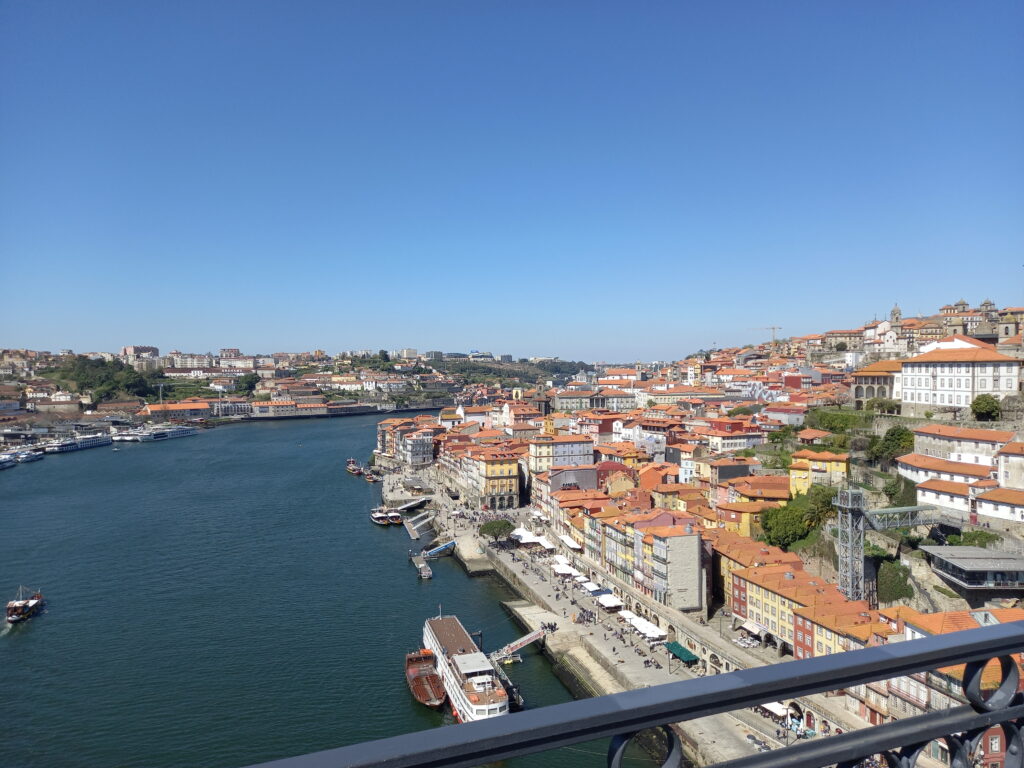
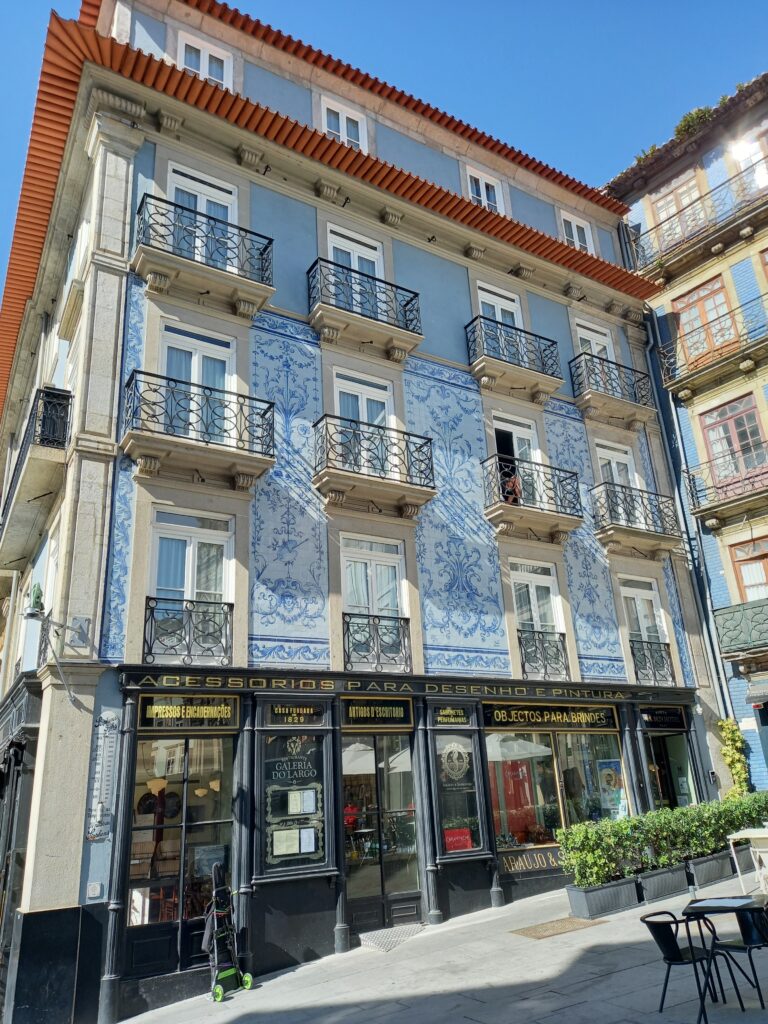
Porto is a charming city built alongside the river. I walked up and down the cobbled hills and had a coffee by the river. There are plenty of back streets to explore and blue tiled buildings including the train station. The cathedrals are a bit more rough and ready and not so spectacular as Spain
I went by train to Aveiro and found it a mish mash of old town; a much vaunted “Venice “with a few gondolas floating about in the canals. The old town is delightful and I ate sitting outside. So far, I have found the food to be superior to Spain, healthier and not just a preponderance of bread.
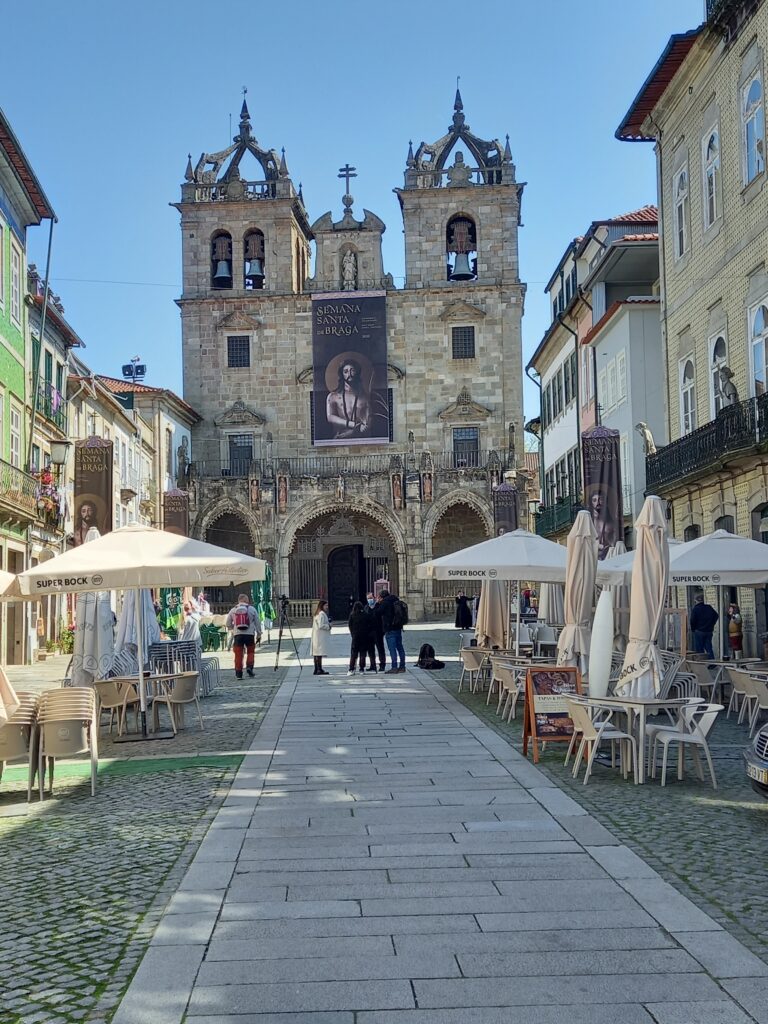
The next day I visited Braga by train, the third largest city in Portugal. This is a real gem, pedestrianized city center with plenty of cafes, cathedrals, houses of interest. One could spend many days exploring the history and architecture of the town. I could certainly live there.
In Porto I took a hop on hop off bus along the coast and watched the surfers and plenty of people exercising, running, walking, biking. The old port wine warehouses have been converted into wine tasting and cafes by the river. Rangers were playing Braga and a number of supporters were staying in the hotel, I only realized they were Scots after a while as their accent was untranslatable Why anyone would travel that distance to watch a second-rate team is incomprehensible to me. All these supporters looked like giant retards let out from a lunatic asylum for the day.

My train to Lisbon was more an express with lots of stops than a high-speed bullet train, but very affordable and packed. Getting on and off was a bit like a rugby scrum but with bags.

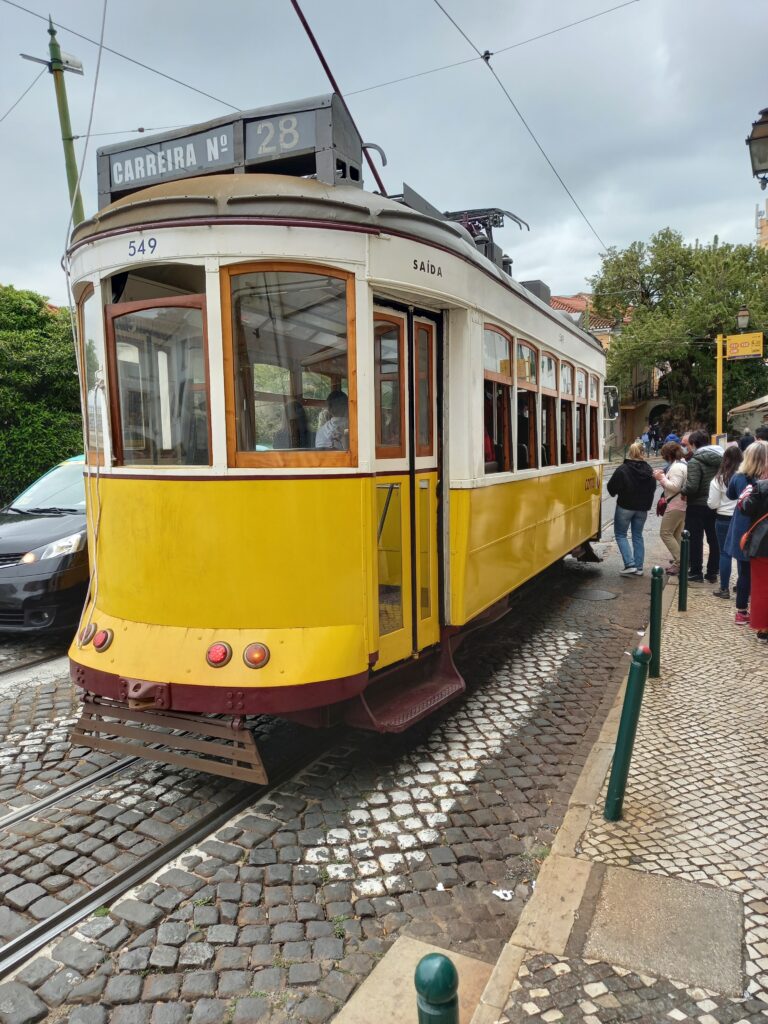
Lisbon is a somewhat bigger version of Porto and very touristy. I sometimes think these places are a theme park laid out for tourists. I spent the first day going up and down the hills to the castle, there were huge queues here to enter so I gave it a miss. On I went through the narrow lanes, stopped at the Thieves Market where I bought a wallet and lost my umbrella. The next day I caught a hop on, hop off bus through the more modern city to the extensive water front, then up on the old tram through the narrow lanes. This was good fun , the old tram making its way up the hill through the narrow lanes. . We met a car coming down which had to back up the hill.

I then caught a train to Sintra, packed with tourists. Again I felt that this was more a theme park than anywhere else with tour buses, tuk tuks , guides meeting the train. It was a bun fight. I started to climb up to the castle on the top , reached the walls but realized that I would have to wind my way round the hill to the entrance and the hordes. But I got away from the crowds. I just found everything a bit too much and jumped on a train back home.

The longer you stay in a city the more you like it and like all the others Lisbon has grown on me.

When you travel I think you should have a purpose. Joining the throngs ambling around is a waste of time. Either study aspects of cities, i.e., architecture, art, language or do a trek, cycle tour. In this case we will now look for some property to buy.

Patrick and Carol arrived and I met them at the airport. We moved to an Airbnb; it was nice to have space to move around in instead of living in a cupboard. On our first day we went into Lisbon by tube and did the other half of the Hop on Hop off bus. This was through the newer part of Lisbon and we strolled along the river next to a huge convention center with restaurants, hotels. We then took a tram, the wrong one, which clanked its way through tiny streets. We stopped next to a café and I could have reached out and drank a girl’s wine from her table through the open window. We passed parked cars with maybe 1 inch to spare. The tram dropped us off in a suburb, using Google maps we walked to the nearest Metro station and then home.

 This brings to an end my 6 days in Lisbon. An intriguing city. The next time I come I will explore some of the museums such as the tile museum.

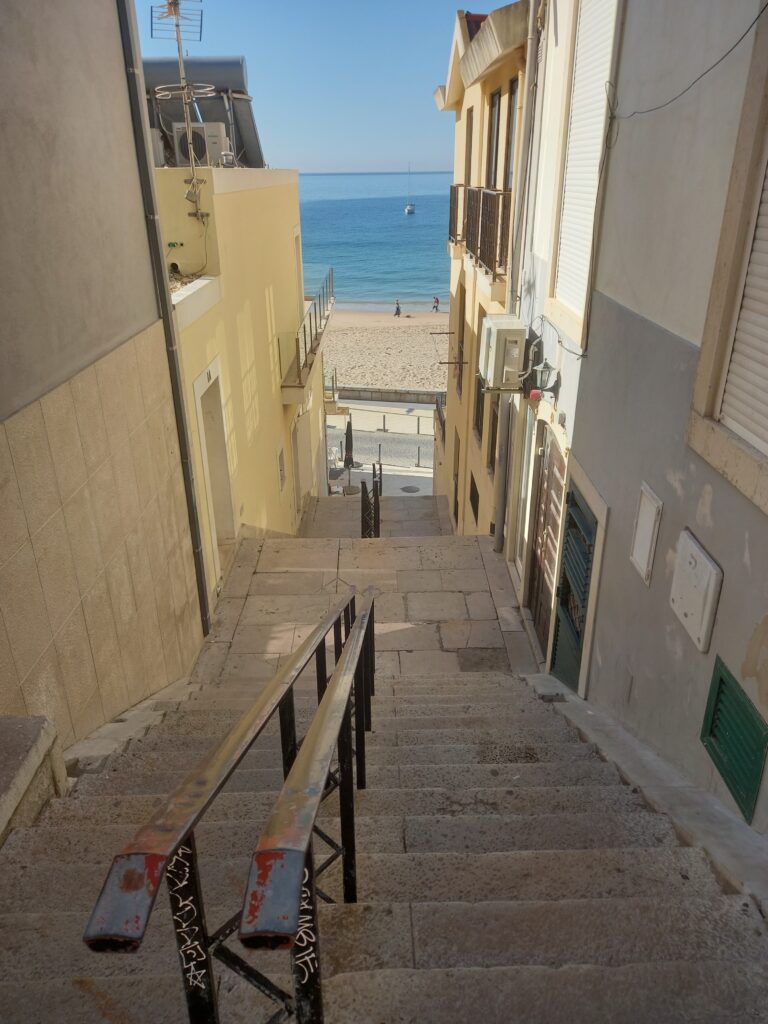
We took an Uber, about 40 minutes, to Sesimbra , on the coast. We stayed in the old town, a stone’s throw from the beach. Our Airbnb is so small you can’t swing a cat around but we manage. It’s a small alleyway with a flat above us, down the street is a tiny grocery store. Washing is hung out in the street. The beach is beautiful and the weather perfect maximum 21C. We walked to the yacht mole, had a pizza dinner by the sea, and the next day walked up the hill to the castle with stunning views over the bay.
This was Easter weekend and very busy, on Sunday we had a fish dinner sitting outside with a wonderful view of the sea. As well we took a walk to the fishing harbor.

Impressions of Portuguese people are good; friendly, helpful and many speak English. There are many shops selling delicious cakes, bread . We look out for lunch time specials in the restaurants.

Another bus trip to Azeitao , an old village in the wine country , where we went to Bacalhoa wine farm and had a tour around the old palace there with a wine tasting . It’s a beautiful place owned by Joe Berardo who had originated mine dump mining for gold in SA. We also met three SA women, one of whom has immigrated to Cascais which is North of Lisbon.

When it comes to property its quite clear that buying something by the sea is expensive. We took a hike up the hill to obtain a view over the bay through the rather ugly developments up the hill. 60M2 is a normal size for an apartment. In fact, everything is on a small scale in Sesimbra, the small supermarkets are tiny and one tends to be doing waltzes around other shoppers and workers stacking shelves. The people are also quite small, we saw a tall blonde girl in a café and knew she was either from Scandinavia, Germany or Holland, she was from the latter.

We went to the market in Setabal, a feast of colorful fruit and vegetables, meat, cakes, and most of all fish. We took a  walk around the old town with its alleyways and shops. All the towns we have been in are a mixture of spruced up properties and ruins waiting to be done up, a huge contrast often next to each other.

Our next move was to St Luzia , a small town in the Algarve. We accomplished this by Uber to the nearest railway station, a train to Faro and then an old two coach train to Tavira. We talked to a young lady at the station café who had lived a lot of her life in UK and then moved back to Portugal. She said the economy in Portugal was weak and the minimum wage was 600 Euros per month and rentals were Euro 600/month. When we arrived at our Air BnB we had a snack at the nearby café and had a chat with the owner who had also lived in UK for a number of years. We are staying in a beautiful apartment; I think we are the only ones staying in the block but I guess it becomes mayhem in August. But this is luxury compared to where we stayed in Sesimbra.

And then Covid struck me down, at first, I thought it was flu but it became a bit too severe for that. I count myself lucky in that I didn’t catch it in Sesimbre where we were all on top of each other, here there are 2 bedrooms,2 bathrooms, and plenty of space. Covid was pretty painful for me, sore throat, and being also overwhelmed by streaming mucus.

But after a week I was almost back to normal and able to appreciate our surroundings. In this part of the country, you are next to the sea but not, there is a channel through a marsh with the beach on the other side. It can be reached by walking across a bridge or a small train or a ferry boat. Otherwise Santa Cruz is 3 kms from Tavira and consists of a fishing harbor for octopus , small attractive narrow streets and apartment developments. I have the feeling we have missed the boat so far as cheaper properties are concerned in this area.

After Covid we took a walk to Tavira which we found to have many tourists in the center with a mix of older and newer buildings.

We do the most of our shopping at a local supermacado , cramped with shelves packed with stuff. It’s a different lifestyle in Portugal, small, cramped dark apartments, guys drinking tiny espressos or something stronger in cafes and restaurants.

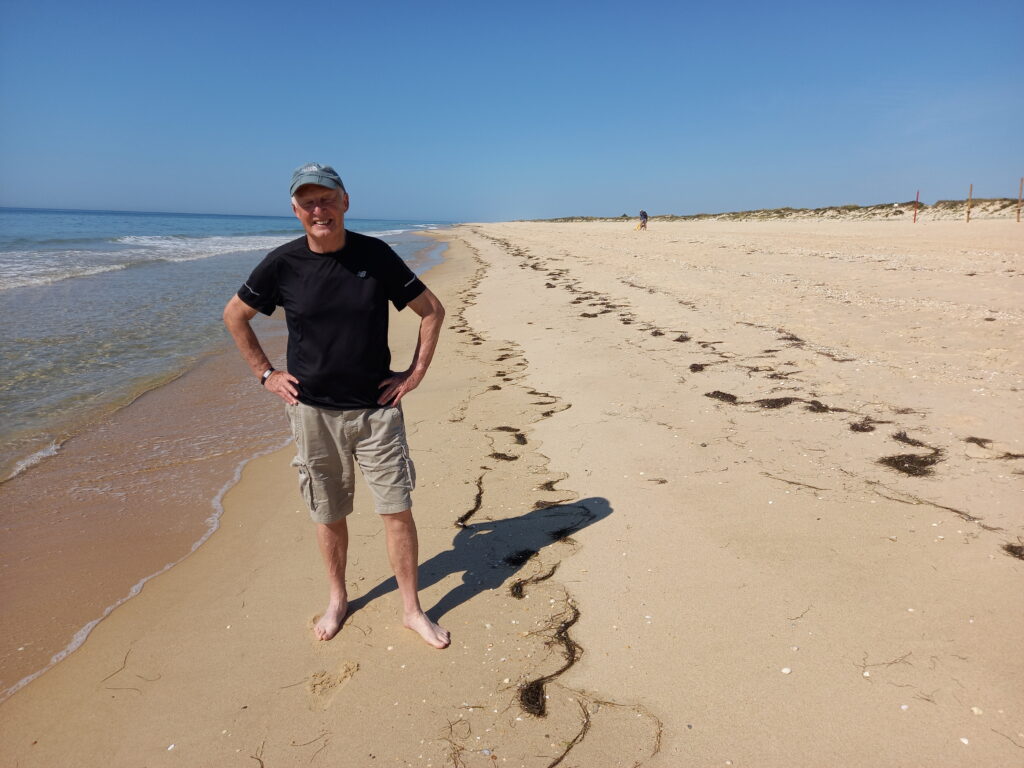
We took a ferry to the Island of Tavira and walked along the beautiful empty beach and had a nice coffee. We’ve also walked to the local Aldi store through the countryside with vines and flowers. The weather is getting hotter by the day.

At this time, I am thinking hard about my life and what’s to follow. Whether I live in Durban or Portugal is immaterial. It’s filling the time, feeling useful, fulfilled and content. On one of my walks I passed through an estate of beautiful houses with a center piece of a hotel , café , pool and sitting area. What a beautiful place to live.

At this time of year the majority of people are grey haired; many retired people in Europe are well off; good pensions, secure financially. Most people come for the sun, peg themselves out on the beach or by the pool and burn themselves a bright red tomato color.  I can understand that people from dark ,rainy ,cloudy countries crave the sunshine and getting a good tan . I can see their reaction to the sunshine and the heat; they love it.  As we stay in the Algarve it’s getting progressively hotter ; so now I take a walk in the morning and the rest of the time chill out. We saw an old man foraging for herbs in the grass, fields of wild flowers, pigs and sheep.  I must say that it’s somewhat boring staying here because it’s off season but it’s helping to clarify my mind for the future.  Currently I believe I will keep my base in SA and continue to travel. Why bury myself in Portugal? . What does work for me with travelling is mindfulness, I live each day as it comes.

We took a train to Vila Real de Santo Antonio, a small picturesque town on the river with Spain on the other side. It has an extensive yacht harbor and a well laid out old town. Another good place to retire.

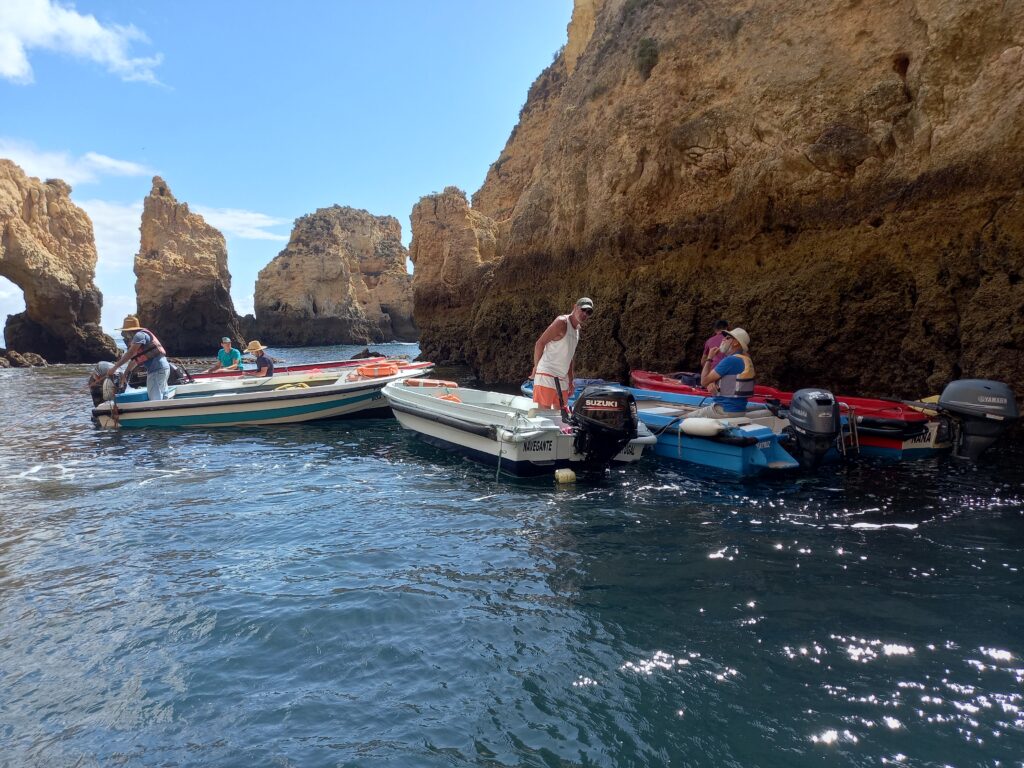
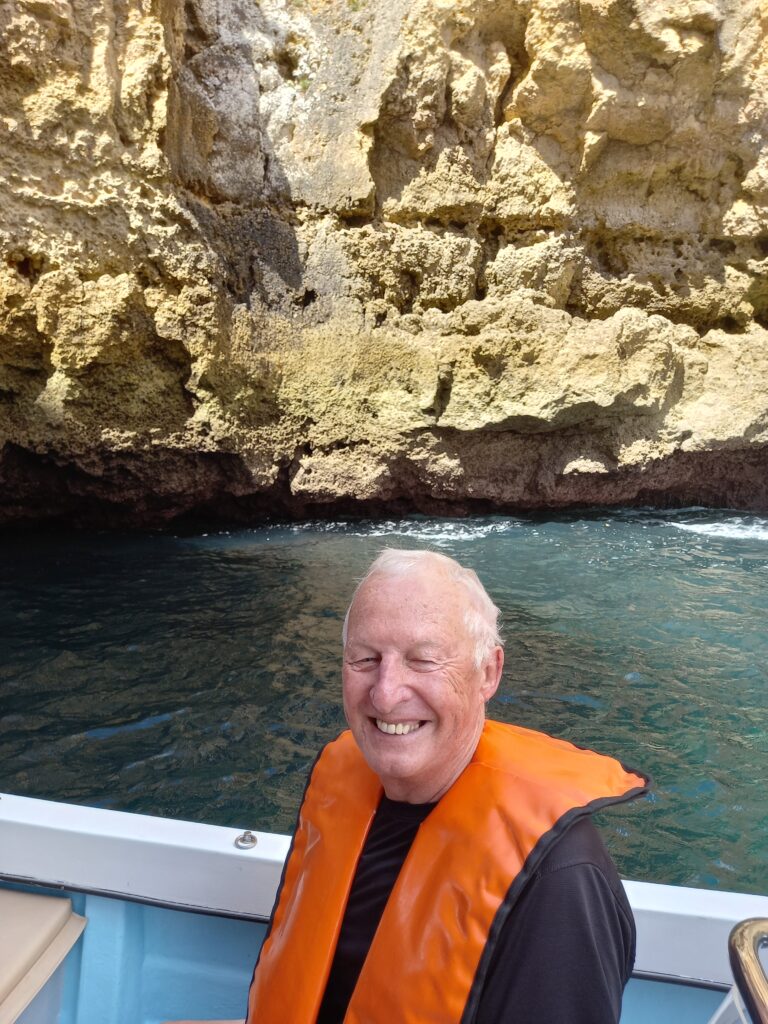
The other two moved North for a year’s rental and I caught the train to Lagos. This is a bigger town with an old center, a harbor, a long beach and other smaller beaches hidden amongst the cliffs and crags. Its rather touristy but there’s lots more to do than Tavira. I’m staying in a house with a pool and kitchen which is shared with Chileans, a Danish lady who walked from Lisbon, 300 kms, and guys from Holland and Ireland who are digital nomads. There is an alternative life style and they are living it. This stretch of coast has these weirdly shaped sandstone cliffs and I first walked them and then the next day took a boat and went through little arches into grottos and caves. It is a truly spectacular place with plunging drop holes in the ground and in between hidden beaches.

I took a bike ride to Luz and Burgau , small towns along the coast. All went well except it started to get hot on the way back and I find I get burned with the strong sun. The beaches are superb all along the coast. I also went by bus to Sagres which is the furthest town in the West by the Cape of St Vincent, soaring cliffs, turquoise water, a constant wind and lots of surf shops. The town has an end of the world feel and the scenery is similar to the Cape of Good Hope. The bus takes its time , taking loops off the main road into small villages , sometimes even doubling back on itself. At one village there was a hippy looking girl with a rusty old bike, an open suitcase and lots of packets, shopping bags, rucksacks and the like. She opened the bus luggage compartment to put the bike in but the driver stopped her and wouldn’t allow her to board.

Now I’m puzzled as to how people can lie on a beach for hours in uncomfortable heat turning themselves into lobsters and running the risk of future skin cancer . Most of them have awful bodies anyway

In the meantime, travelling by air to and from UK has become very stressful with many cancelled flights and long queues. Sure enough my Wizzair flight to London was cancelled at midnight and I spent two hours on my phone finding an alternative flight, at high extra cost.

My time in Spain and Portugal has come to an end. The original idea was to look for a place to live so what has changed? Although Portugal lives up to its reputation, good weather, friendly people, reasonable cost of living, the cost of housing in the coastal areas and major cities is prohibitive. The alternative is to live up in the North in a housing area , most of which are rather sterile and ugly. What would I do with myself each and every day cut off from friends and family? Although the health service is reputed to be a good one, at home I have a GP who knows me with all of my notes, a heart specialist and a private service which I can afford. So if Simon, my son, wishes to buy a property for his future in Spain or Portugal then I could help him financially and to locate somewhere.

Spain 2022

I flew to Barcelona by EasyJet from London Gatwick , an easy seamless experience. I then walked the wrong way for miles lugging my case before realizing my mistake on Google maps and turning around and finding my hotel.
On my first day in Barcelona, I walked 16K to the Gothic Quarter and back, wonderful narrow alleyways and then the Picasso Museum, mainly his early work. Barcelona Cathedral is majestic; Impressions of Barcelona are good; there is some wonderful architecture. Youngsters zoom about

on electric scooters, bike lanes on major roads. There doesn’t seem to be a lot of traffic jams, probably due to the good public transport.

I spent the day with Janet, an English teacher who has been living in Barcelona for some time. We walked up to Montjuic , a hill overlooking the city with wonderful views. The Olympic stadiums and diving centers are up here. Janet told me Spain is a beau acratic nightmare. She has a good life in Barcelona; a nice flat that she shares; lots to do, she likes partying despite her age, friends, the Montjuic on her doorstep to exercise in.

The hours here are completely different. Work starts at 09.00, followed by a big lunch at 2.00.and then back to work at 4.00pm followed by dinner at 9pm.

Everybody picks me out as an Englishman before I speak a word.

I found a South African bar; the lady serving is Norwegian married to a South African.

I visited the Sagrada Familia, a huge soaring unfinished cathedral built by Gaudi. It’s a remarkable building but I can’t help thinking that it has some trashy features on the exterior but the interior is amazing.

I had trouble with the metro ticket so walked home and a bird proceeded to shit all over me from a dizzy height. A kindly fellow helped me clean up.

So, the next day I moved on by high-speed train to Madrid and arrived in pouring rain with another detour courtesy of Google maps. I probably didn’t type in the name of the hotel correctly or didn’t differentiate between driving and walking.

Madrid must be one of the world’s most wonderful cities, a vibrant, moving, elegant place. It has huge museums, wide boulevards, palaces, splendid architecture with squares and lots of bars and restaurants. And a lot of walking.

I met Olie my grandson and Natalia in the Park Returo , he’s a lovely boy and I feel quite sad that he can’t be a part of our lives on an ongoing basis.

I visited the Royal Palace, walked the streets and squares. The police are everywhere; people demonstrating and police watching them carefully. Cycling, as you would expect is big and people zooming around on electric scooters. I bought a book at a book stall and came across old guys with stamps and coins in the square. On Sundays the people congregate in the center of the city and eat a meal or drink a beer.

So on to Toledo with a short 30-minute train ride. The old city sits on the top of a hill. It has two large cathedrals, lots of smaller churches and narrow alleyways linking them up. So I spent my time wandering around slowly, recuperating from the stresses of Madrid and Barca.  I’m not so impressed with Spanish food, lots of bread, ham and cheese but the architecture takes your breath away.

 I climbed the tower of one of the cathedrals despite warnings to people with cardio problems vertigo, senior citizens etc. Toledo is just wonderful, it has such a mish mash of architectural styles and all encompassed in narrow alleyways.

From there on to Segovia by train via Madrid. The train left from a different station which meant catching a taxi from one station to another. There are thousands of taxis in Barcelona and Madrid but on arrival to Segovia there were none.  A bus was stood there with Centro on it so I hopped on and then walked up the hill to my guest house. The place is down a narrow alleyway and dark inside with no one around. I rang the number and a lady appeared who checked me in. (sort of). The next issue is laundry and I traipsed around town until I found one which was staffed and friendly.

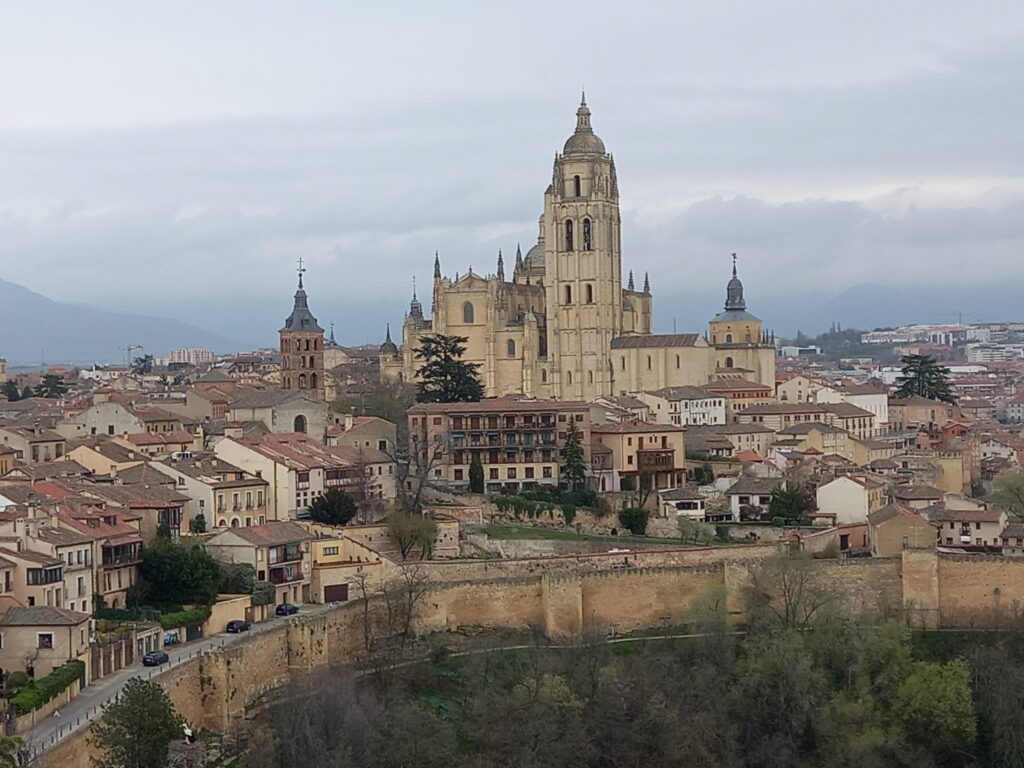
Segovia is cold with snow on the hills but again a really lovely place. I went to the Alkazar de Segovia, the Royal castle built on an outcrop high above the valley. I climbed the tower and huffed and puffed a bit. I walked the old town and generally sorted myself out with future bookings and transport.

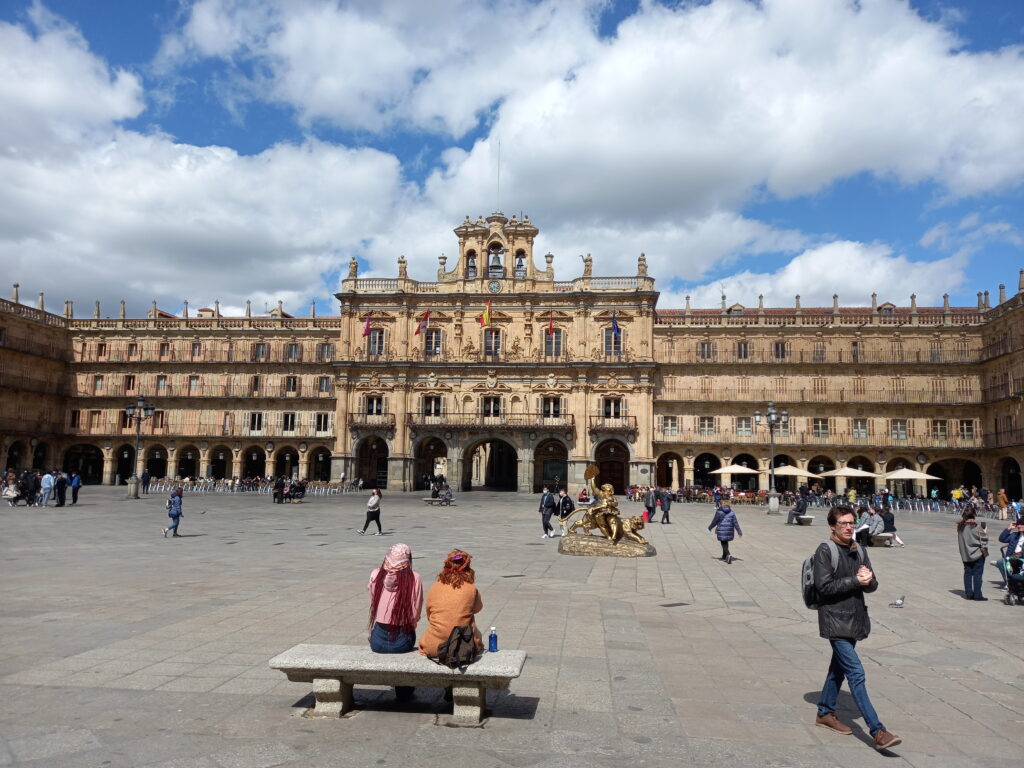
From there another train ride to Salamanca, past hills covered with snow; this time I’m staying in a cupboard next to a main road. Once again, these Spanish cities never cease to amaze with their architecture, soaring pillars, stain glass windows, tombs, paintings. When I entered the cathedral a lady told me that this was the new cathedral which was built from the 16th to the 18th century . So I asked her “when was the old cathedral built?” Mattter of factly she told me “ in the 10th century”. The Plaza Major is a huge square teeming with people eating and drinking. But there are quiet gardens next to the cathedral to sit and ponder. But it’s cold to linger or sit outside. Many restaurants don’t even open in the evening until 8.30 pm

There’s a strong similarity between Salamanca, Toledo and Segovia; all are built on hills and their cathedrals forts and monasteries dominate the countryside. The centers are all pedestrian ways with narrow alleyways leading to squares, some like Plaza Major in Salamanca are huge with masses of people sitting outside enjoying a drink.

 I walked to the bus station early on Sunday morning with the temperature -3C and caught the bus with one change to Porto.

Spain is much more than crowded beaches and summer vacations. There are still more fascinating cities and villages to visit in the future.