Week 2 – China

[foogallery id=”448″]

China Week 2

To continue our journey we flew from Kuala Lumpur to Beijing via Air Asia. All went well until we drew cash from an ATM. We either were given counterfeit money from the ATM or had good money swapped by a taxi driver later. Our hotel was close to Tiananmen Square and the Forbidden City both of which cover a huge area. Carol kept saying that it’s a public holiday but that wasn’t the case, the number of people visiting these sites is enormous , estimates 80,000 per day. We filed past Mao’s body in the mausoleum being urged on all the time by the overabundance of police and minders. People laid flowers, some wept and there was an overall feeling of reverence. From there we walked through the Forbidden City , the scale of which is enormous. The next day we took a trip to the Great Wall and walked and climbed marvelling at the fantastic achievement that made this possible. We stopped at the Ming tombs and braved the hectic traffic back to the city . Our driver took a shortcut to avoid the snarled traffic and got the bus stuck in an alleyway. A shouting woman ran out and blocked us with a bicycle and stones but we gingerly reversed and turned around. It was nice to meet some intrepid travellers, Barbara a 70 + American who just travelled wherever she felt like it following the sun or her whim, two free spirited Belgian girls and 3 Filipino girls who live in Singapore. On our last day in Beijing we took the metro to the Summer Palace which is beautifully situated next to a lake but rather spoilt by hordes of people. But what does one expect , China has 1.4 billion people and over 20 million living in Beijing. In the evenings we walked the hutongs ( alleyways ) around the hotel into the poorer residential areas .
Our impressions of Beijing are that it is a huge city with wide clogged roads and highways, magnificent architecture and history, miles and miles of high rise buildings . In general the Chinese are not friendly to foreigners and overcharge and not particularly honest , there’s a huge security presence. Very few smiles are handed out and the people appear gruff and confrontational.
Beijing West is a frantic station with masses of people but we found our way to the huge waiting room for our train which was somewhat like being in an airport. The train itself was impressive, 16 coaches long, comfortable and new and reaches speeds of 300 kilometers/hour. A good way to travel.
Pingyao is an old walled town, the first morning Patrick and I ran the circumference 6.2 kms and saw one guy doing martial exercises with a sword, groups of women doing aerobics and people singing . Inside the walls the town consists of small traditional houses converted into shops , restaurants, hotels , no cars and old museums and temples to view. So we spent the days and evenings strolling around and eating and people watching. In fact both in China and Malaysia we have covered a lot of ground. The food is divine noodles soaked in vinegar, pot roast beef, green tasty vegetables and other pork or chicken dishes. We have found that an evening meal with drinks costs the same as 3 cappuccinos. So I think that in future we will be giving our coffee breaks a miss.
Our hotel is in traditional style with a huge bed that could sleep 6 but a hard mattress and a pillow filled with rice. So Patrick and I wake up wrecked with pains and sores and walk around like old men until we loosen up.
I would recommend Pingyao to anyone to visit when in China. The people are far more friendly and helpful than Beijing.
Some difficulties, no Google and Facebook , no one wants to sell us a SIM card, no pharmacies , worrisome ATMs and very little English spoken. Actually the latter leads to some fun situations with all sorts of people being hauled in to translate and explain the dishes.

Malaysia August 2017

[foogallery id=”445″]

So this is the start of a one year round the world trip. I believe it’s important to approach this with a positive, adaptable, patient mind set. There are going to be delays, frustrations, possible accidents, bad accommodation, losses, maybe robberies, feeling sick; so we’ll just take them in our stride. I’m not going to start thinking about what’s going on at home or the coming experiences; I’m just going to concentrate on the here and now and remaining mindful.

The flights from Durban to Kuala Lumpur were totally contrasting even though with the same airline Emirates. The flight from Durban to Dubai was crowded, uncomfortable, cramped and with bad food. From Dubai to Kuala Lumpur we flew with a new A380 which was spacious, had a state of the art entertainment system and had good food. It took us over an hour to clear immigration at KL.

We are fortunate to be able to stay this first week with my great niece Gemma and her husband Adam who are teaching in KL. They have an apartment on the 18th floor of a high rise block in the suburbs and are next door to a newly completed MRT driverless state of the art train which takes us every day into KL on our explorations. The public transport is cheap and efficient and in town there are buses for free on four circular routes. It took us a little while to figure out the different railways, bus routes and fix them with the sights we wanted to see. Young women jumped up and offered me their seats, I’m not sure whether this is just inherent politeness or that I appear old. On the train one guy jumped up and then we compared ages and found he was 1 year younger than me. So I kept the seat. One morning as we arrived on the platform I dived into the train and the doors shut immediately with watched  Patrick and Carol with bemused expression on their faces on the platform as the train slid away from the station.

The cost of living here is cheap, rentals are reasonable, eating out is a joy and cheap. I think most people don’t bother to cook; there is a huge choice of restaurants and pavement food from all over the East. And it’s delicious.

The city reminds us of Hong Kong, Bangkok and Singapore. Frantic development, hectic traffic, huge buildings, 5 star hotels, a mall society and here and there little pockets of old KL and peace and quiet. We visited the up market craft market with batiks, silver and pewter goods and then the Petaling Street market which has the cheap fake branded goods together with an authentic Chinese pharmacy which displayed animal innards and old tins of ginseng at $1500 each. Carol asked the pharmacist if he had rhino horn available; he said no but we can get it nearby.

The central gardens are a peaceful haven set in the middle of the roaring traffic and high rise buildings. We visited the bird park , and the wonderful orchid and hibiscus gardens .

The city appears to be a well ordered, governed multi ethnic and religious society. I know this is an over simplification and just an observation.

So we will be back in less than two months to explore more of this country and surrounding neighbours.

Tamsin

IMG-20151228-WA0003 IMG-20160612-WA0001 IMG-20151208-WA0000 IMG-20161207-WA0000

Tamsin

I have a very unusual grand-daughter Tamsin. She doesn’t think she’s unusual because her life has always been the same since she was born but other people shake their heads in wonder at the things she has experienced in her 12 years of life.

She has lived all her life at Phinda Game Reserve in Zululand South Africa where her parents live and work. Initially she went to a pre-primary school for children of employees but now she goes to Hluluwe Primary School. To get there each day the children drive 40 minutes through the game reserve and Tamsin told me that on one day she saw the big 5, that’s lion, leopard, elephant , rhino and buffalo; a bit different from most people’s drive to school.

The staff live in an area next to the airfield and particularly at night it’s best to keep your eyes open and tread warily. Lions march down the road past the houses and elephants come regularly into the garden to drink from the bird bath.

From an early stage Tamsin has accompanied her Dad in carrying out his tasks as Conservation Manager. This means she’s been there when they’ve darted elephants, leopards and lions to fit collars, rhinos to remove horns and helped out when the vet has cleaned up wounds on injured animals. She has no problem to swab out maggots from an infected leg or stomach. These operations don’t always go strictly to plan, on one occasion a partly anaesthetised elephant got angry and turned over the truck in front of where she and her mother were watching , injuring and trapping the driver.

Flying in helicopters and planes to spot animals from the air is no big deal for Tamsin .

She recently went with Simon to Malawi to relocate antelope from one reserve to another and in the near future she’s going to a private island off the coast of Zanzibar to do something similar.

She is also responsible for rearing and feeding orphaned antelopes which are kept in her Dad’s garden. This includes bottle feeding them every 4 hours when they are young.

Of course we all believe that she’ll follow in Dad’s footsteps and pursue a career in conservation. But that’s not a given, who knows Tamsin is just as likely to become a fashion designer or an accountant. It’s going to be interesting to see.


Annapurna Part2

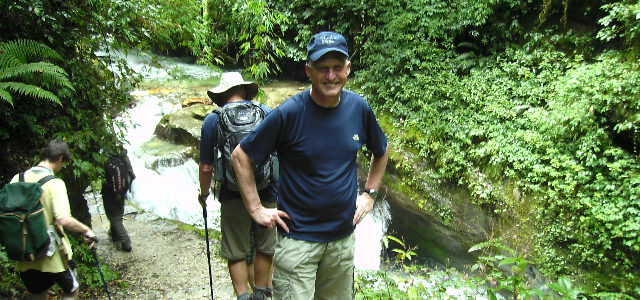
On day 3 we were woken up at 04.30 and by torch light climbed Poon Hill to see the sunrise over the Himalayas. It was worth it, our first real sight of the Annapurna range with the first rays of the sun catching the summit of the highest peak and then gradually moving down until all the snow covered peaks were brilliant and glowing. There were a lot of trekkers up there and the mood became almost euphoric; people dancing , pulling funny poses and running happily around and taking photos.
Ours was the first Gap trek after the monsoon and there was still a lot of rain about. There was a weather pattern, dawn would be clear and peaceful and was the best time to view the mountains. As the sun rose higher water would evaporate from the soaked earth and form clouds and mist which would gradually obscure the mountains. Morning walking would be hot and humid and we would sweat buckets and then by the afternoon it would start to rain lightly. Evenings it would often clear and then we would see the most amazing sights sometimes completely by accident . We would be gazing at white fluffy clouds and then with a delighted shock realise that peaking out above the clouds would be a snowy mountain top. Often it would rain all night.
We progressed to walking through forests; bamboo, rhododendrons and wild flowers interspersed amongst the trees. Here we had to watch out for leeches, they would lie in wait on leaves and jump on to you and then make their way on to your skin and suck your blood. We used to check each other out and remove them but some escaped our attention, I found a bloody sock one evening and a mark on my neck.
With so much water about the waterfalls were truly spectacular. They were everywhere, falling vertically for hundreds of metres, crashing into rocks at the bottom and forming fountains. The scale of the Himalayas is awesome, raging rivers, steep mountain sides where land slides and avalanches roar down and mist which would suddenly swirl and then part giving glimpses of the snow covered peaks high above.
It was high up on the mountain we had an earthquake , I felt it as a 30 second shake of the bedroom with the door frame moving backwards and forwards but the others said it was 2 mins. It was 6.5 on the Richter scale and killed people in Kathmandu. A dog had followed us up the trail and had adopted our room to sleep in until I threw him out . I thought it was him trying to get into the room.
Only on the last day before base camp did we break out of the forest and walked through grass land. Then our luck deserted us and it rained heavily with thick mist. We slogged on and up and at last in the late afternoon stumbled up to Annapurna base camp, 4100 meters high. By then we were tired, wet and a bit miserable but our luck hadn’t entirely deserted us because later again the mists cleared and we caught views of the mountain tops , boding well for the morning.

And in the morning our luck came back ,the weather was clear and we were on the edge of a glacier and surrounded 360 degrees by the Annapurna range, impossibly high peaks cloaked in snow and glaciers ; all of them between 7and 8,000 meters high. Again the mood of the trekkers was exuberant, people dancing, whooping and doing cartwheels. Amongst it all were sheep herders living in a smoky bivouac tending their flocks. I think Ben felt quite at home. I couldn’t help thinking about the mountaineers where the base camp is just the start of their climb to the top. I couldn’t imagine how they summon the effort and will power to climb those summits.
Our luck really was out on the way down, it chucked it down. From then on it was wet clothes, socks and boots and often wading through paths pouring with water. It’s here where good gear is invaluable, I was lucky in that I had a 1st class rain jacket and pants but Adam seemed to do the trek in a yellow T shirt, cut off jeans and an umbrella and he suffered. We descended on a circular route and crossed the longest suspension bridges on the way down These swayed alarmingly as we walked and often we could see planks which had fallen off lying on the banks of the churning , roaring rivers way down below. One tilted dangerously to one side and we held on like grim death to the highest guard rail. The Nepalese health and safety inspectors were conspicuous by their absence.
We reached Pokara by the third night after base camp, and bliss; long hot showers, steak and chips and a chance to dry our clothes. Then it was one more time on the bus ride from hell back to Kathmandu, a lovely last dinner and then the following day people made their way home.
When we were climbing Poon Hill we saw early morning planes flying down the valleys and then swooping over the cols to continue on sight seeing trips of the Himalayas. They were below us as we continued to climb the mountains. Ramesh , the tour leader, offered us an opportunity to fly on one on the last day in Kathmandu. We all turned it down . On that day an Everest sightseeing plane crashed on the approach to Kathmandu and everyone was killed. On my return I read that Sir Edmund Hillary’s wife was killed in the same way many years ago.
I stopped off overnight in Dubai and the contrast with Kathmandu was amazing. I moved from 3rd world to not just 1st but a future world. What an influence our politicians and leaders have over us to create such contrasting states.
Trekking in the Himalayas is demanding physically but very rewarding. I take back with me memories of soaring peaks , misty valleys , beautiful indigenous forests, tranquil farmland in almost impossibly steep hillsides and everywhere the sounds of water rushing along in rivers and waterfalls . Last but not least I won’t forget the friendly helpful people, always courteous and always smiling

Annapurna . September 2011 Part1

Annapurna Nepal  September 2011.


There’s a one-eyed yellow idol To the north of Kathmandu; There’s a little marble cross below the town; And a broken hearted woman Tends the grave of ‘Mad’ Carew, While the yellow god for ever gazes down.


Milton Hayes and Cuthbert Clarke 1911


Well I think I roomed with Mad Carew, an Aussie from Perth called Ben. When first coming across the delights of Nepal toilets he found there was no toilet paper. No problem, he used the lavatory brush; he said it was very effective. Ben used to go missing whenever we were about to go anywhere and then someone said he’d been seen on the back of a scooter wending his way through the crazy streets of  Kathmandu. He was very proud of his alarm clock but seemed unable to set it so it would go off at 3 o’clock in the morning. He would sit bolt upright in bed, switch it off and then turn over, go back to sleep immediately and start snoring. I, of course, was unable to get back to sleep. On our list of things to take was a sarong; Ben said he’d hunted high and low through Kathmandu but couldn’t find one. Pity; Ben waltzing about the Himalayas in a sarong would have been a wonderous sight.

The tour was organised by an international company called Gap and throughout we were accompanied by two leaders and on the trek five porters who carried our packs leaving us with just a day pack. We were 11 participants , mainly poms but also a Polish couple , a German lady ( don’t mention the war ) , a father of my vintage  and his son from USA and of course Ben from Aussie. I’m glad to say the group got on well together and helped each other along when things got tough.

I thought Ho Chi Minh traffic was bad but Kathmandu takes the biscuit, everything crammed into narrow streets; cars, buses , scooters with whole families on them, cows , dogs, chickens , children, trucks all accompanied by the constant sound of hooting horns and black diesel fumes. I’ll never complain about potholes in South Africa again; most of the time in Kathmandu the road surface is just potholes linked by bits of tar, so one just lurches along. Luckily traffic mainly proceeds at not much more than walking pace

.On day 1 we visited two temples, Bodhnath stupa which is in the heart of the Tibetan community and Swayambhunath stupa which is on the top of a hill and is the monkey temple with its Buddha eyes . I found both temples fascinating and watched people making protestations or lighting candles, ringing bells, turning prayer wheels , some ladies in a trance or others just meditating. However I’m still trying to get my head around what I saw at Bodhnath; a Buddhist monk dressed in saffron robes gave this stray dog a mighty kick that Wayne Rooney would have been proud of.

We then walked through Kathmandu to Durbar square which contains the palace of Kumari Devi who is an 8 year old  living goddess. Our day coincided with a festival where she goes in a chariot through the streets and when we arrived hundreds of police in riot gear and guns were assembling. Our tour guide advised us not to go which is a pity because the braver amongst us did and caught wonderful sights of her.


The next day was a bus trip to Pokhara, a 200km journey which took 8 hours!! The main hurdle is the pass out of the Kathmandu valley which is a bit like Sani Pass but with trucks. Inevitably a truck breaks down trying to get up the pass and major gear box or transmission repairs are carried out on the road. There’s only room for one vehicle to pass and a log jam then occurs which takes much shouting and cursing to sort out. This pass is not for the faint hearted; often we would turn the corner to see two trucks side by side heading straight for us; not to mention the more or less vertical drops down hundreds of metres with wrecks of trucks and buses clearly seen at the bottom. At one stage we got out of the bus and walked down the hill and waited for the bus to catch us up.

We started the trek the next day after a short bus ride from Pokhara. We trekked for 10days; on most days we walked from 08.00 to 16.00 with breaks for morning tea and lunch. There was very little level walking, it was either up steeply or down steeply. Often we would grind up to the top of a hill only to descend down the other side, losing all the hard won altitude,  in order to cross a raging river by means of a suspension bridge to get to the other side of the valley. The advantage of this is that we gradually acclimatised to the altitude and had no troubles when we reached the high spot of the trek. Afterwards I mentioned to my friend that I found the trek tough and in typical blunt fashion he replied “What did you expect, you were trekking in the flipping Himalayas not Richmond Park”

Nepal is one of the poorest countries in the world and the majority of the 25million population live by subsistence farming. They are descendants of Indians, Mongols and an Ayrian race and you just don’t see any fat Nepalese, they haven’t yet been introduced to KFC or McDonalds. Particularly in Kathmandu one realises that poverty means many people living together in one room and a consequent lack of privacy ; we often saw women washing themselves at a tap by the side of the road, lack of choices in life, jobs , money   security and health care. When Buddhism refers to a life of suffering it’s always been hard for me to understand this term. Now I do. Yet the Nepalese are a good looking race, well dressed, particularly the women in their traditional clothes, school children in uniforms, tolerant and dignified .

The first part of the trek goes through villages and farmland with steep terraces where rice, millet , barley ,potatoes, mealies and other vegetables are grown. The richer farmers have buffalos and oxen and we often had to make way for donkey trains as everything has to be carted up the mountains. Higher up where the tracks are steeper and rougher manpower does the carting, it’s astonishing to see these small men, all muscle and sinew wearing either wellie boots or flip flops carrying huge loads at a breakneck speed. Unfortunately there are no yaks in this part of the country. Clearly the trekkers have had an influence on the traditional Nepalese culture but generally a positive one by injecting cash and in all cases we were greeted with smiles, friendliness and courtesy . The only negative point was that I had to drink tea out of a Chelsea mug at one tea house because nothing else was available.

I borrowed my friend’s walking poles and these were a life saver ascending and descending the steep paths. We met other trekkers on the way, many were independent and on strict budgets, one lone Englishman comes to mind and two 6 foot Amazon German girls with legs like Steffi Graf who of course had to carry all their packs up the mountain. We stayed and ate in tea houses, basic establishments with the bare essentials but in all cases excellent cheap vegetarian food and even beer for the troops lower down the mountain. Jenny, a 21 year old English girl hadn’t been to the toilet for 4 days because she had an aversion to the squat Eastern type and made a sprint for the first Western toilet on the trip only to emerge gagging as the toilet had no flush cistern. One had to pay extra for hot showers but there was no in between, they were either boiling hot or freezing cold. Needless to say the guys would play tricks on the hapless Jenny, tell her she could go first for a shower and then nip in quickly and bag the shower , which made her furious. ”What sort of man are you Adam to pinch my shower.” When she did get in to the shower we would shout to her the wrong instructions on how to operate the complex series of taps to enable her to have hot water. “ Now turn the left tap clockwise full on “ and then screams as she got a full on cold jet straight from the glacier. Needless to say she would get her revenge , she’s a marathon runner and on the Loughborough University track team so she  would shoot up the steep climbs leaving us all far behind..

Kathmandu

Laos,Cambodia 2012 Part 2

Victims
Victims
Tower of skulls
Tower of skulls
Pnohm Phen Palace
Pnohm Phen Palace
Phnom Phen palace
Phnom Phen palace
Vientienne
Vientienne
Vientienne
Vientienne
Bus to Luang Prabang
Monks receiving alms
Mekong
Mekong
Luang Prabang
Luang Prabang
Luang Prabang
Luang Prabang

Now I was on my own. I wanted to get to Luang Prebang in Northern Laos and as a first step took the bus to Phnom Penh. The bus was quite luxurious with air conditioning and a hostess but painfully slow along badly pot holed roads. I stayed at Paddy Rice above an Irish pub and on the boulevard along the Mekong River where in the evening, when it went a little cooler, it seemed like to whole city took a promenade , played football and did aerobic exercises and just generally hung out.
I took a tuk tuk to the Killing Fields memorial. This was an experience in itself, hectic traffic, choking fumes and lots of potholes. At one stage I had to get out and lift the rear out of a hole otherwise we were stuck slap bang in the middle of the road.
In 1975 Pol Pot led the Khymer Rouge into Phnom Penh (see the film The Killing Fields) and forced all the inhabitants out into the country to fend for themselves. During this time an estimated 2 million people died out of a population then of 7 million . Many were killed in purges; government officials, doctors, lawyers, anyone with any education and this was one of the many killing fields. The memorial is well done; we were given a moving audio commentary spoken by survivors. The centre piece is a large tower filled from top to bottom with skulls and clothing recovered from the site. Our guide at Ankor Wat had lost both his parents and lived as a refugee in Thailand until 1992 before returning to Cambodia.
So when one looks at Phnom Penh now one must remember the recent history, the Vietnam War and the carpet bombing by the Americans and the devastation wreaked by the Khymer Rouge followed by the Vietnamese invasion. Now Phnom Penh is a seedy, crumbling but busy city. I visited the enormous Grand Market which is consumerism gone mad with fake brand watches, clothes, jewellery contrasting with the general poverty of the people. Talking with the people I found that they work 12 hours a day, 7 days a week for maybe US $ 50 a month.
In contrast I visited the highly ornate Royal Palace and the Silver Pagoda built by the French in the late 19th century inside is a beautiful jewelled Buddha.
In Phnom Penh there were quite a few Western old pensioners about. Generally they could be split into two categories, intellectuals visiting the museums and temples and the disreputable who seemed to rise late, drink beer and eat all day, go for massages and then frequent the girlie bars at night. You’ll have to decide which category I fitted into.
I enjoyed eating on the street in the evening, sit down and the locals will always come and chat. The food is good and remarkably cheap even for us South Africans, I just had to put up with the traffic fumes and the odd rat scuttling across the road.
But there were times in this last week when I wondered what I was doing there and that I should have just caught a plane home but in hindsight it was worth it as you never know if or when you will return to that area and what’s a week in a life anyway.
I established there was a bus to Luang Prabang but it took 2 days to get there so I opted for a flight to Vientiane, the capital of Laos. Sitting next to me was a Vietnamese girl, travelling with her grandmother, with an accountancy degree from Australia and even she couldn’t get a job in Vietnam. We talked about rhino poaching and the use of the horn in Vietnam and she said that if the population believes that the horn helps them little or nothing can be done to change their minds.
Vientiane is a contrast to other cities in the East, wide boulevards, less traffic and much cooler weather. I took a tuk tuk tour around the city and saw That Luang , the city’s holiest site ,Wat Phra Kaeo ,the Victory Monument , modelled on Paris’s Arc de Triomph and took a walk around the city’s main museum. Laos has a conservative approach to tourism, nightlife closes at 11.00pm, women wear traditional dress and life is lower key than Bangkok or Phnom Penh. Booking a flight took one and a half hours, after a long process involving phone calls, third parties in the deal and my credit cards were declined. I had to go to an ATM and draw out 1.5 million kip ( about 180 US $ ).
The 10 hour bus journey to Luang Prabang was a real adventure, The bus wound up and up narrow mountainous roads with sheer drops to the river below, crawled over landslides, went past limestone towers cloaked in dense forests and terraced rice paddies on the lower slopes.. The bus made regular stops to drop off and collect goods and ladies came on board selling bread and what looked like 100 year old eggs. The wonderful baguettes and stick loaves are a legacy of the French colonial days.
At first light the novice monks wind their way barefoot through the town in long crocodiles, dressed in bright orange robes and receive alms in the form of food from the ladies kneeling at the side of the road.in containers that they carry
To my mind Luang Prabang is paradise lost, it’s now become a town devoted to serving the tourist hordes. The French colonial houses are converted into boutique hotels, fancy restaurants, gift shops, galleries and the authentic Laos inhabitants can no longer afford to live there. Having said that it’s a quiet oasis away from the bustle of the cities with little or no traffic and is at the confluence of the Mekong and Nam Khan rivers and is a very pleasant town to wander around with numerous beautiful old temples, river views and the King’s palace, built by the French in 1904 and more resembling a private house than a palace, including the cars that he had used. The King and family came to a sticky end at the hands of the communists but it’s easy to envisage in its’ heyday the quiet graceful lives they must have had. In the middle of the town is Mount Phousi and after a sweaty climb to the top there is an airy stupa and stunning views around the area.
The town has a night market and as always good cheap food available at stalls.
Early next morning I drove past the lines of monks in the rain and caught a plane to Bangkok.
This is the ultimate contrast, roads clogged with traffic and fumes, crowded pavements and a hot muggy atmosphere. But Bangkok is now easy to get about on the wonderfully air conditioned skytrain and metro and there’s lots to do and see. It’s an amazing place to go shopping; the choice of goods is phenomenal. At the top of the range are the upmarket department stores with all the major brands but at prices one would see back home. Then there are the medium, lower level stores and then the street markets along the pavements. I went to the huge Chatuchak weekend market and probably only got around about half of it before succumbing to the crowds and heat. Everything was for sale there, food, clothes, ceramics, jewellery, furniture, pets, you name it and you could find it somewhere.
It was quite a mission to find Jim Thompson’s house, a quiet haven almost hidden among the tower blocks, concrete pillars and building sites but well worth visiting. He is credited with reviving the Thai silk industry and his house evokes the Somerset Maugham era and atmosphere with lovely verandas, wooden floors and furniture.
So finally it was time to pack up for the last time and get to the airport for the flight back to Johannesburg.
I can certainly recommend a cycling holiday to anyone, it doesn’t have to be in the Far East; it can be a leisurely ride through France for example, sampling the wine and food. The rewards are open countryside, friendly people, getting away from the crowds, good exercise and most of all lots of fun.

Laos, Cambodia cycle tour 2012 Part 1

Digital Camera
Old lady
Digital Camera
Wat Phou
Digital Camera
Wat Phou
Digital Camera
Wat Phou
Digital Camera
La Folie Lodge
Digital Camera
La Folie Lodge
Digital Camera
Mekong
Digital Camera
Great ladies
Digital Camera
Paddy fields
Digital Camera
Dodgy ferry
Digital Camera
Street trader
Digital Camera
Yes, this is a ferry
Digital Camera
On the road
Digital Camera
Tough cyclists
Digital Camera
Mekong falls.
Digital Camera
Lunch time
Digital Camera
Lunch time.
Digital Camera
Water front
Digital Camera
Village
Digital Camera
Sembor Prei Rok
Digital Camera
Ankor Wat at dawn
Digital Camera
Carved gate
Digital Camera
Ankor Thom
Digital Camera
Banteaway Srei
Digital Camera
Another dodgy ferry

Digital CameraAnkor Thom

Digital Camera
Ta Prohm

Digital Camera

Mad dogs and Englishmen go out in the midday sun
The Japanese don’t care to,
The Chinese wouldn’t dare to,
Hindus and Argentines
Sleep firmly from twelve to one
At twelve noon
The natives swoon,
And no further work is done
In Bangkok
At twelve o’clock
They foam at the mouth and run
But mad dogs and Englishmen go out in the midday sun.

Noel Coward

Our first day on the road started promisingly enough. The cycle tour was organised by Spice Roads and we met on the first day in Thailand on the border with Laos; myself and four ladies, Charlotte and Lisa from USA, Sandra from New Zealand and Son our tour leader .It was there I discovered Lisa and Charlotte had done the Boston Marathon and Sandra was a veteran of 160km rides back home. The next day we crossed the border into Laos and started cycling along a pleasant road , crossing the Mekong for the first time to a small town for lunch. It was here that Charlotte started throwing up spectacularly and opted for the bus and Lisa who was worried about her kept her company. Son told us quietly we had a 20km hill to follow and by then the temperature was stoking up and the sun blazing down. Then Son started throwing up as well whilst cycling on her bike so it was two men down and counting and Sandra was finding it all a bit much having just come out of an Auckland winter .We would pedal up for a while but when our heads threatened to burst it was best to find some shade, take off the helmet and gloves, down an ice cold coke from a road side stall and slowly but surely recover. Near the end of the ride the clouds came over, there were a few rumbles of thunder and it started to rain; blessed relief.
We stayed each night in a good quality hotel, some wonderful, others more basic and ate each night at the hotel or in a nearby restaurant. The food was always great; of course one has to like eastern cuisine and on the whole trip I never once had trouble with my stomach .Lots of fresh veggies, spices and always fruit for dessert. We had a back up vehicle and had regular stops with cold drinks, snacks and wet wipes to keep us going and always stopped for lunch at a restaurant or if none was nearby would hunker down in a temple or a road side stall, sometimes with a pig sniffing round our ankles looking for scraps. On average we did about 70 kilometres a day, some days longer, some days shorter, some of the rides on the road, often on dirt and sometimes on muddy single tracks through the paddy fields.
Things started looking up the next day, the sick girls had improved and we rode up further into the hills and visited three spectacular waterfalls plunging sheer 200meters down through the dense forest, one with a wonderful rainbow. This was coffee and tea country and we rode through plantations in amongst the forests. Whatever goes up must come down and we had an exhilarating 30 kilometre plunge down the hill where we never had to crank a pedal.
It was along this road that I was passed not once but twice by pretty females on scooters who drew alongside and gave me wonderful come hither looks, which hasn’t happened to me for many a long year.( and not likely to happen again). They would then zoom off into the distance with me pedalling furiously trying to catch them up.
We then took the first of many ferries across the Mekong River. On all these ferries I normally said a quiet prayer before embarking. Some took vehicles which looked as though they would sink the boat immediately into the murky waters , other were no more than nailed planks with a lawnmower engine at the back and just big enough to take us stood up and the bikes.
We cycled on to Wat Phou , a Hindu archaeological site dating back to the 5th century, 200 years before Angor Wat. This is a wonderful lost city with ruined pavilions next to a lake and leading up the hillside to the main sanctuary with views over the countryside. We had this more or less to ourselves. We went across to the island of Don Daeng and stayed at the wonderful La Folie Lodge, built by a Frenchman like a lodge back home, all open plan with bungalows fronting the river and a splendid pool next to the beach and with the first of many beautiful sunsets Again we had this and the island to ourselves and felt like kings (and queens), being waited on hand and foot by attentive friendly staff. Honestly everything was done for us, loading and unloading the bikes off the ferry, cleaning and oiling them, plied with drink and food; all we had to do was pedal.
This area is known as the four thousand islands and the next day we cycled around the first of a number of them. Most of the time we cycled on muddy tracks with vistas of people working in the bright green paddy fields with palm trees on the skyline dodging geese, dogs and on one memorable occasion two guinea fowls that were obsessed with following us trying to cross right in front of our wheels. Then on we went through villages and houses made of wood and often on stilts to keep above any floods. And everywhere smiling people and particularly children running next to us shouting “sabaidee” like a chorus from houses, gardens, trees and surrounding us when we stopped in villages, smiling shyly. Charlotte took a couple of tumbles in the mud and we succeeded in dodging low cables strung across the track and I rode once into a low flying bunch of bananas.
Then back across the river and up one of Son’s “little hills “ to Phu Asa. This was a low point for me; we had a walk in ferocious heat up and up to an archeological site Xe Pian with strange stone towers. I struggled to walk and only found out later that my feet and ankles were badly swollen.
Later we watched children playing in the river whilst we took a ferry to our hotel.
After a lovely ride the next day on another island we eventually crossed to Don Khong where for the first time we were back in a touristy area with rather hippy bedraggled backpackers hanging about. It made us realise how lucky we were to have the freedom to cycle away from all this and see the country as it should be seen. In this area the wide Mekong River plunges down a number of impressive waterfalls which defeated the French colonists’ efforts to navigate by boat and we rode to a number of these. We also took a boat to the middle of the river and saw the rare and endangered Irrawaddy fresh water dolphins, quite a sight to see these wonderful creatures seemingly so far from the sea that we associate them with. Near the hotel was a village and here I watched village life. The ladies together prepared food for the children which they all ate together. No fast food here, all fresh veggies and fruit. Later some of the children took food and left it in the temple and the novice monks duly came and took it to their quarters. A boat came down the river and dropped off supplies which the children carried to the village. It made me realise that communal living like this has disappeared in our Western society. My Mum had it in her neighbourhood in Manchester where the community looked after each other but where I live now it’s every man for himself and nobody cares a hoot for his neighbour.
The next day we rode to the Cambodian border and said goodbye to Son. She was a great tour leader, helpful, caring, and happy and on top of it all a good cyclist. That evening, next to the hotel, I explored a temple and the head monk came out and greeted me. He ran a school for the novices and the number one subject is English, we promised to keep in touch after I returned. I knew that my friends would never believe me that I made friends with a monk.
In Cambodia we rode along dirt roads next to the river, over rickety wooden bridges and through traditional Khymer villages. Now we were followed by cries of hello, hello and as well as rice there were other crops and general subsistence farming. We also rode by a large rubber plantation. The heat in the afternoon was intense and I suffered from sunburn on places like my fingers and patches on my arms and legs. I sweated so much that the sun lotion was washed off and putting it on top of a film of mud and sweat was disgusting. Lisa said that she thought it was appropriate that we were going through hardships because it was in line with the suffering that the local people have been through and still have to endure.
We had another cruise to see more Irrawaddy dolphins, I find it remarkable that they appear to stay in one small area of the river so they are not difficult to spot but they are a critically endangered species and with all the pollution in the river one wonders how long they will survive.
We rode to Sembor Prei Rok , built between the 6th and 7th centuries ; a number of temples scattered around the jungle with spectacular fig trees , interspersed with giant craters from the B52 bombings in the Vietnam war. This was also the area that Pol Pot initially operated in before he took over the country. Again we had the place to ourselves, we were way off the tourist track . By now I was craving steak and chips and after our normal Eastern lunch was astonished to see another Spice Road group served with just that. My eyes nearly popped out of my head.
From there we transferred to Siem Riep and Ankor Wat. Siem Riep is a town catering for the mass tourism business and reminded me of similar towns in Phuket. This really only came on the mass tourism map over the last ten years after the Tomb Raider film But during our three nights there we ate well, had a fish massage where small fish to nibbled away at our feet with an extreme tickling sensation and watched traditional Khymer dancing with beautiful willowy girls in traditional costume doing graceful things with their arms and hands. I reckon after the show they put their jeans on and buzzed off on their scooters. The town also has a large night market.
Ankor Wat itself is the largest religious monument ever built and was established in the 11th century and was the centre of the Khymer Empire and there are many other temples extending in a 25km radius .We cycled around the area , along walls, past temples and through extensively carved gates.
We saw the sun rise behind the main temple with its five giant towers and later walked around it. It’s simply too vast to take in on one visit, it has galleries, terraces, towers intricate bas relief carvings, a moat and of course the five sandstone towers.
The empire crumbled in the 14th century and the jungle took over and was only discovered by the French in 1873 .Apart from looting many of the greatest carvings they commenced restoring the complex which is still going on today.
Ta Prohm is the most spectacular temple as the strangler figs have taken over and the roots have forced their way through the foundations giving the unique sight of nature overcoming and destroying mans’ finest efforts to tame it. In many cases it looks like the roots are growing out of stone. We also cycled through the carved gate to the royal palace of Angkor Thom.
By then we were getting a bit templed out. We rode in traffic around the town; quite simply the road rules are that there are none, particularly at intersections. The predominantly scooter traffic just goes for the gap; you just hold your line and say a little prayer.
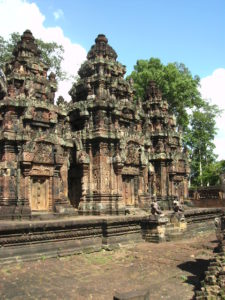
On our last day we rode 50 kms to Kbal Spean , walked up a thankfully shaded wooded hill and saw submerged carvings under the river and a small waterfall. Our guide told us that in the forest there is another ruined temple but it’s not accessible due to land mines in the area. Afterwards we went to Banteay Srei which has exceptional bas reliefs and carvings.
In the evening was had our farewell dinner and then at 07.30 the next morning we went our separate ways; the American girls to the Thailand beaches, Sandra to New Zealand and me to Phnom Penh. It had been wonderful sharing this with such great companions

First World v Third World

09-25-first-vs-third-world-nationalism[1]

I’ve recently realised that the gap between 1st world and 3rd world countries  is growing not narrowing and it’s interesting to investigate why. So here are a few observations based on my experience of life in first world countries such as UK, Switzerland and Germany and third world countries such as South Africa, Sri Lanka, Nepal, Philippines and Zimbabwe.

Firstly the traditional definition of first world countries is countries of the developed West e,g. UK, America, Western Europe ,and including Australia, New Zealand, Japan and Korea. Second world countries are from the previous Communist states; Russia, China, and Eastern Europe and third world countries are from Africa, India ,Far East and South America. There’s also a failed state category either through war or mismanagement which includes Somalia, Syria, Libya, Iraq and now Venezuela.

Every day 3 million passengers use the tube system in London. This is part of an integrated public transport network of rail, bus, tram, light overhead rail and tube. A passenger purchases an Oyster card which is swiped on entry and exit to the station or bus and which can be topped up at automatic telling stations or directly from a credit card. No cash, no fuss, no bother. It’s not all sweetness and light though with the main problems being overcrowding at rush hours. London Transport continues to invest in new lines, systems, and trains and buses. Switzerland and Germany have, if anything, an even better and more efficient service and France has a wonderful network of high speed trains. Living in these countries it’s not necessary to own a car.

Compare this with South Africa where public transport has been handed over to the minibus taxi industry which has an increasing lobby with the Government and disputes any move to improve public transport with intimidation and violence. Drive by shooting a la Al Capone is common amongst warring factions. Apart from the Gautrain, which is a limited, elitist new railway serving the more affluent areas of Johannesburg and Pretoria the rail network has been allowed to deteriorate and is dangerous to travel on due to crime. So more and more cars and taxis are pouring on to the already traffic clogged roads. The rail network is all there, it just needs vision and investment to update and bring it into the 21st century.

The grid locked cities of the Philippines are worse. Most people’s mode of transport is being jammed onto a motorised tricycle or a jeepney, which is a modified American Jeep pick up with bench seats. Sitting in one of these means being shoved next to your neighbours, stifled in the heat and high humidity, choked by diesel fumes and sitting for hours in the continuous stopping and starting of the traffic. One Sunday it took us 2 hours to drive 8 kms to a friend’s house in Cebu City.

Kathmandu is a also a city where driving on the roads is a nightmare with many old , beat up cars, trucks and buses belching out black smoke on pot holed narrow, inadequate streets. Travelling the 200kms from Kathmandu to Pokara by bus took 8 hours and was a slow, bumpy journey on narrow roads filled with Tata trucks which frequently broke down and blocked the road whilst major repairs were carried out. The only alternative is by small plane which is more dangerous with frequent crashes in the mountains.
People quite simply earn less in the 3rd world.

I talked to the hotel receptionist in Vientienne , Laos and she told me she earns US $50/month for working 12 hours/day , 7 days per week .

The 1st world has 16% of the population and enjoys 78% of the world’s GNP. Working conditions are often poor; clothing manufacturers often turn a blind eye to the sweat shops that produce their high value branded products sold in the West at high cost. Rates of unemployment are higher in the 3rd world but it’s interesting to see that in South East Asia the population are very innovative in setting up stalls on the street selling anything from cooked food to carrying out scooter repairs. They don’t sit around and bemoan their fate like in South Africa. And there’s no welfare state in the 3rd world, no cradle to grave system to pick up the bills when things get tough. Switzerland recently held a referendum where the proposal was the Government would pay each adult SFr 2000 /month and each child SFr 600/month in view of increasing unemployment due to robots taking over jobs. The Swiss people actually voted against it. Can you imagine that in South Africa?

Where are all these jobs going to come from that Governments talk about with their job creation promises? Every company is intent on increasing productivity, reducing head count and automation.
Japan has the highest life expectancy in the world at 84 whilst South Africa is 60 and the worst is Sierra Leone at 46. Looking at the charts 1st world countries have a far higher life expectancy than 3rd world countries. Diet, exercise, superior medical conditions all contribute to this and 3rd world countries have to deal with wars, HIV Aids, chronic diseases such as malaria, malnutrition and inadequate medical systems. As a continent Africa suffers from the lowest life expectancy in the World.

Population continues to grow at a higher rate in 3rd world countries than 1st world countries; in fact in countries such as Japan and Italy the population is declining. Better education, women pursuing careers and a focus on life style means that couples make a conscious decision to limit the size of their families. Although with younger families In South Africa family size would seem to have decreased its very common for grandmothers to raise children whilst single mothers have to be the bread winners. In the Philippines the population continues to grow thanks mainly to the Roman Catholic Church’s policy on birth control. But this does mean that grandparents have a role to play and a place in the family. They are looked after in old age and not just shoved into old age homes when they become infirm.

The route to a prosperous and thriving country is through educating the population ; South Korea achieved its aim of becoming a 1st world country by education, discipline and hard work. Currently South Africa is in the middle of an” education transformation” which in effect means dumbing it down. Students would like to have a free education consisting of turning up at the end of three years and receiving their degrees without attending lectures or taking exams. And in the meantime the schools frequently have 70 students per class and being taught in bare concreted schools with broken windows and zero facilities.

1st world countries have established democracies with independent judiciaries and strong policing. 3rd world countries have weak financial systems and the rule of law and governments are highly corrupt and nepotism and cronyism rule the roost. Any Government position, even a minor one, is highly desirable because it gives the incumbent access to the honey pot.

Nothing gets done in service delivery because there’s no money left over after the increasing army of Government employees have creamed it all off. Witness the sad slide of South Africa since Zuma took over as President and the abject poverty of Mugabe’s Zimbabwe.

In the World Happiness Index 2016 it’s no coincidence that Denmark was 1st followed by Switzerland and Iceland. The ratings were based on GDP per capita ,social support ,life expectancy, freedom to make life choices, and perceptions of corruption.

It’s a sad world we live in. 80% of the world’s population live in poor housing, 50% don’t have enough food, 24% don’t have electricity, 17% don’t know how to read, only 7% have access to the internet and only 1% have a college education. Meanwhile the rich get richer and the poor get poorer.

Everest Base Camp 2013 part 2

[foogallery id=”232″]

The next day it really felt like we were getting closer to the mountains with the high peak of Thamserke dominating the skyline ahead of us. We dropped down to a river which had water driven prayer wheels . After lunch we started the long slog up to the monastery but disaster befell us.

On the first stage of the climb the path was narrow and very crowded with trekkers. Suddenly a panicking out of control yak came rampaging down the hill with two gas bottles swinging about in the air. I thought it was going to take Simon out but at the last second it swerved and ran over Elmien. She was badly trampled and had a severe twisted ankle, it was only when she returned to South Africa it was discovered that the ankle was broken; a real yak attack. What to do? She decided to continue on a hired horse and carried on like that to the end of the trek. Those prayer wheels didn’t work for us that day.

We continued up to Tengboche Monastery at 3,860 meters high , made famous by Hillary and Tensing on their conquest of Everest in 1953 and then down to our night’s stay at Dlboche. Many villages we passed through had Mani stones, large boulders inscribed with prayers. When we started walking the next day we passed a Mani wall, a long wall in the middle of the path made up of countless inscribed stones which one must pass clockwise. Then we passed through an enchanted forest, lovely glades with pools and boulders covered with lichen. Overhead the trees were adorned with old men’s beard, quietly stirring in the breeze.

Later the forests on the opposite hills were ablaze with autumn colours and it was hard not to believe we weren’t walking in Scotland. From there we walked through grassland sprinkled everywhere with wild flowers, red, blue and yellow colours covering the ground.

Often it’s difficult not to allow the mind to wander: I spend too much time thinking about the past and the future rather than the present. Up in the high Himalayas I had no such problem, there’s so much to concentrate on , flowers , birds , spectacular mountain scenery , shrines by the side of the road and not least negotiating the rocky trail. Exercising at high altitude mean that just putting one foot in front of the other requires a concerted effort. Getting in and out of the sleeping bag at night left me breathless.

The next day was a “rest day” so we went straight up the nearest mountain for 500 meters in the mist as part of “acclimatisation “. Our lodge was in a valley and the sherpas were farming veggies and looking after their yaks. We urged Wayne to go for excellent photo opportunities into an adjacent field where there was a fierce looking hairy yak bull which chased everybody in sight , but by now we all had a healthy respect for these beasts. Wayne has an alter ego, in another life he would like to be a paparazzi. Don’t fall asleep anywhere in public because Wayne will snap you, careful where you go to the toilet because Wayne is lurking behind a wall with an itchy finger on the trigger.

The next day we trekked through a wide beautiful valley covered in wild flowers with fantastic views of Cholatse and Tawache with the mist lingering on the lower slopes. The path then snaked steeply through the boulders of the Khumbu Glacier terminal moraine. Here there is a site with many stone cairns built in memory of many of the climbers and Sherpas who have died on Mount Everest. We followed the glacier to Lobuche , a rather bleak collection of huts at the foot of the Lobuche Ice Fall. Now we were at 4,300 meters and it was noticeably colder which didn’t stop the students going for a swim and wash in the ice cold stream.

In the early mornings helicopters came up the valley taking people on sightseeing trips, collecting injured or sick trekkers or delivering goods. They were a spectacular sight ; one time we watched as a helicopter did loops in the air to gain height to pass over the glacial moraine. Imagine our surprise later when we learned that Nico had taken a flip , he probably passed over the top of us as we puffed and panted up the hills.

On our trek we kept pace with other trekker parties from all over the world. Five Czech men and women were on a Do It Yourself trek with the aid of the Lonely Planet Trekking guide to Nepal , carrying their 17kilo packs up there themselves. Jana, one of the group, told me that she preferred to spend her money on trekking around the world rather than on a mortgage . She would work, save money and go off trekking again but her parents worried about her. Lakshika , a single girl from India, had hired a guide and was doing the trek on her own. She said she preferred doing it that way without having to bother about other people and their problems. She had very understanding , liberal parents because Indian girls are normally restricted in what they can and can’t do.

There were lots of Chinese, many of them spitting images of my students at Maritzburg. A few times I nearly shouted, “Hey Zoe, hey Marco what are you doing here? “ The girls were all identical , covered from head to toe in trekking gear even when it was hot ; big cowboy hats , a scarf across their faces ,a huge pair of round glasses , gloves and knee guards on the outside of their trousers, giant cameras , all wending their knock kneed way up the mountains with the aid of walking poles.

Then there the Aussies, we gave them a hard time as we had just thumped them at rugby as well as cricket earlier in the year. They didn’t like it, but they’re quick to dish it out when they win, so I felt nothing. Other groups from UK were also walking to raise funds for deserving causes, hospice, heart foundation and prostate cancer amongst others. We met Nepalese trekkers who put us in touch with the author of a book on rhino poaching in Nepal but unfortunately we had no time to meet up later. An Aussie lady and her daughter were trekking to distant lakes with the aid of a porter they had hired. They trek in the region every year. Everyone had one thing in common, a love of adventure and trekking in high places. The rhino suits caused lots of interest, particularly Elmien on her horse, and we became well known on the route.

The next day was the final push, following the Khumbu Glacier up to Gorakshep. Trekking was hard up there at 5000 meters and when we reached our destination at lunch time I made the decision to sleep in the afternoon rather than go to Everest base camp. I thought about it for a while and then decided to give it a bash; it would have been a mistake to go all that way and cop out at the end. I would have regretted it for the rest of my life. I started earlier because the younger guys were walking faster than me. The path follows the Khumbu Glacier and up there it’s wild and barren and like a moonscape. The ice is covered by rocks but there are glacial lakes with ice cliffs and every now and again the deep and threatening sound of an avalanche. One more hill, one more bend and we were finally at base Camp .

The route up Everest can clearly be seen with the summit sitting behind the twin peaks of Nuptse and Lhotse. We had made it. Photos, high fives and a good feeling of achievement. I couldn’t help thinking about the men and women over the years who had stayed months at the base camp and then gone on higher to climb the peak. Putting up with no showers for weeks, melting snow for water , illness, effects of altitude, bad and cold weather and the climb itself requiring courage , strength , technical ability and above all else a strong determination to succeed. I take my hat off to them. One in two people of my age, 60 and above, die attempting the summit. Over 200 people have died on the mountain and many of their bodies are still up there.

During the night it snowed and the next morning we set off in the dark at 04.00 to climb Kala Pattha. Higher up we could see lights snaking up the mountain as we set off through the snow. The temperature was -5C and fingers and toes were numb. Simon set a good pace , afterwards he said he gauged it by the sound of my breathing and I just concentrated on putting one foot in front of the other to keep up with him .After scrambling over rocks covered in ice we arrived at the top, 5,545 meters high and the climax of the trek. The sky lightened and we waited for the first of the sun’s rays to hit the mountain tops. We were literally at the top of the world with Everest right across the valley and surrounded 360 degrees by soaring snow covered peaks. Photos were taken, hands shaken and all too soon with the sun now strong and bright we descended through the snow for breakfast.

All we had to do now was descend in 3 days the 75 kilometres we had already covered. We started in bright sunshine with the snow melting off the roofs but later the weather changed and a strong cold wind started to blow across the valley. I was caught out and had only packed my rain jacket in my rucksack. The only thing was to walk as fast as possible to keep warm. It was here I made my first mistake and followed the Irish group down the wrong path and eventually one of the sherpas came panting up and pointed me in the right direction. Never follow the Irish anywhere.

So it was back the way we had come and up and down the hills and valleys. The highest suspension bridge is built over the top of one considered unsafe and condemned. Simon and Wayne had just crossed over the high bridge and were resting on the other side. “There’s some idiot crossing the unsafe bridge, hang on it’s Dad “How I came to cross the wrong bridge I’ve no idea.

Mistake 3 came at lunch time, I walked on and on and felt decidedly grumpy that the group hadn’t stopped for lunch. After a while it dawned on me that I must have walked right past the lunch stop ; by now I was tired and slowing down so I stopped at the next shop , went inside , sat down and had a coke and Mars bar. It must have been at that time that Duncan, who had been despatched to find me, must have run past and turned round and run back. So feeling refreshed I started again and then one of our sherpas found me. I told him to turn round, tell the guys I was OK and continuing on to Lukla. Eventually I heard a shout, “You bastard ! “ and there was Simon and Wayne walking full speed down the path. By then we were nearly at Lukla and in deteriorating weather we made it to the Guest House and put our feet up. The end of the trek.

The airport had been closed all that day due to bad weather and the following day proved to be the same. It was there that I discovered that Simon and Michael were bar billiard champions; they took on all comers in the Irish and Scotch pubs and beat everyone. Being good at snooker or billiards is a sign of a misspent youth and Simon admitted that he and his friend used to play after Tech in their student days in Cape Town. We spent the day shopping, drinking coffee at Starbucks and checking out the weather every half hour.

The next day was a little clearer and suddenly there was the sound of a plane’s roar landing at the airport. There was a mad rush to the airport and an almighty clamour at the check in desks to get on a plane. We were very aptly given prayer flags by our Sherpas .This is where being in a group pays off and our fixer and mover had the bags checked in, piled on to a trolley , boarding cards issued and then we were through security and waiting for our flights. We watched awe struck as decrepit looking fully loaded planes struggled up the short rise to the top of the runway , turned round , revved to full throttle and then seemingly hurled themselves down the runway and off the end into the abyss. The most disconcerting thing is that the whole town turns out to watch the planes land and take off, all with cameras and videos at the ready to capture the film of the century of a plane crash.

All too soon it was our turn. We were held on the tarmac, the plane landed, taxied to a halt, shaky passengers got off, bags off, new bags on, we were rushed on to the plane, doors shut , smart stewardess gave us a sweetie and we were off trundling up the incline. Simon closed his eyes and put his head on the seat back in front of him. Elmien grabbed my hand and then we were off, roaring down the runway with the drop off at the end getting closer and closer. Then we were up and away and the relief was palpable. Actually the flight was fantastic if you could forget about possible accidents as we skimmed so close to the mountain tops watching the Nepalese working in the fields, villages and rice paddies sculptured on the hillsides. We were so close you could see the whites of their eyes. And then we were back in Kathmandu with another rip roaring landing.

We had two part days in Kathmandu, enough time to do some shopping and go to the Botanical Gardens. Four of us crammed into an old beat up Japanese mini car taxi and fought our way through the traffic with streaming eyes and gasping lungs. The gardens are a quiet oasis amongst a traffic maelstrom, certainly past their best and a reminder of long gone colonial days. The four of us suffered afterwards with chest and cold infection, a souvenir of Kathmandu and its’ traffic pollution.

The flight from Kathmandu to Dubai was filled with mainly young, small Nepalese male migrant workers travelling to become part of the poorly paid, unskilled , abused labour force in Dubai for building the new developments there. Nepal has a population of 25 million, half of whom are illiterate and of whom about 2.5 million live in the Kathmandu area under very densely populated conditions. The majority of the population are subsistence farmers and the population continues to double every 30 years. We who were born in the affluent West are very privileged. The world has a population of over 7 billion, 80% live in poor housing , 50% don’t have enough food , 24% have no electricity and most of the other 76% only use it at night , only 7% have access to the internet and only 1% have a college education. The world population is expected to grow to between 8.3 billion and 10.9 billion by 2050 , the densest population is in Asia. It’s hard to see how the world can sustain this population growth.

This was a wonderful adventure and thank you to my great travelling companions and their worthy cause. Rhinos continue to be poached in large numbers and face imminent extinction. We saw fantastic natural sights as well as wonderful local culture and friendly, helpful, peaceful people living in difficult conditions. Whether the Everest region tourist capability is sustainable is also questionable. In the meantime I would recommend any adventurous, moderately fit person to go and trek to Everest base camp; it’s a truly wonderful experience.

Roger Naylor November 2013

Everest Base Camp 2013 Part 1

[foogallery id=”222″]

Everest Base Camp 2013

This trek was organised by Pretoria University male residence students as a fund raising exercise for Save the Rhino. The students set a target of R100, 000 to raise by sponsorship from companies, schools, organisations and individuals and far exceeded that by raising close to R160, 000. Three full rhino suits were made and were worn by everyone in turns on the trek. This was a bonus when we reached high ground but lower down, when it was hot, proved to be somewhat uncomfortable. Altogether the party was made up of 15 and consisted of students, mothers, fathers, and wild life conservators. Ages ranged from 21 to 68 and a big plus for me was to do it with Simon who was representing and Beyond.

We started with a day’s tour of Kathmandu which I had visited two years earlier. We stayed in Thamel , an attractive area catering for trekkers and tourists with alleyways crowded with travel agents, restaurants, gift and trekking  shops  where one can kit oneself out with gear for a fraction of the price in South Africa. A first visit to the city comes as a culture shock; it feels like one has been immersed into a kaleidoscope of sounds, sights and smells. The traffic is a nightmare of old small Japanese cars , luxury SUV’s, beaten up buses ,bicycle rickshaws, scooters weaving in and out , sometimes loaded with whole families ,most of whom don’t wear crash helmets and all thrust onto narrow pot –holed lanes winding through the centre of the city. Mix this in with cows, packs of very bold dogs, pedestrians ranging from small kids on their way to school, women in brightly coloured saris, and shops opening straight on to the street selling everything from baths to yak meat. Overall is the on-going sound of car horns being used continuously and fumes which make one’s eyes water and chest tighten up. Surely one day this city will become grid locked as more and more cars and scooters pour on to the road. The most impressive thing is that you don’t see aggravation or road rage like on our roads, people just accept the situation and get on with it.

We visited Durbar Square, Bouddhanth and Swayanbhunath stupas that I had visited before. The temples are not sterile, dark cloistered buildings like our churches and cathedrals but lively active places where people sell souvenirs, turn prayer wheels, make offerings at shrines, prostrate themselves in worship and allow monkeys and dogs to run riot. Then we visited a small factory where Tibetan ladies hand spun and wove traditional carpets. Afterwards we went to Pushapatinath where the Hindus cremate their dead. By custom the cremation is carried out within 3 hours of death, the body is not taken out through the front door but a hole is knocked out through a wall. The body is wrapped in orange and first the feet are dipped in the river before being put on the pyre. The head of the family must conduct and start the fire by placing the torch into the mouth of the deceased. Friends and family watch, and the head of the family has to have his head shaven and eventually the body remains are tipped into the river after about 3 hours on the pyre. We saw children in the river searching the remains for gold teeth or rings. Then a young boy stripped and dived into the river and was swimming around next to the burning bodies. Afterwards the family have to adhere to a strict protocol for a number of months. It’s shocking for us Westerners to see this ceremony for the first time , I won’t forget the images of burning bodies , the  pall of smoke rising into the sky, relatives and friends crowded next to the river , holy men and just general hangers on watching from the other bank . Our guide said that in the East people have time but no money whilst in the West we have money but no time. But we do tend to shy away from death whilst the Hindus meet it head on in all its starkness.

Next morning it was off to Kathmandu airport for THE flight to Lukla. The internal terminal is a bit of a free for all, firstly you are greeted by many porters grabbing your bags and making off with them towards the terminal. They all want a tip of course and we worked out that Wayne must be the only tourist ever to negotiate $2 off a porter for carrying his bag. Then it’s general mayhem; luckily we had a fixer and mover who smoothed the way and no doubt back handed us on to the plane. We drove out to the tarmac on a bus and then took bets on which dilapidated plane the bus was going to stop at. Finally it drew up next to this circa 1st World War jobbie which was stuffed with newspaper on the wings and minus one engine. There was much moaning and gnashing of teeth but then the real plane came forward. It was a Dornier; those things that used to drop bombs on London in the 2nd world war! So we got on board and by then were becoming slightly hysterical. The plane had a flight attendant who squeezed past us, handed out a sweet each then sat at the back looking quite unconcerned. The take-off and flight were fine and we had wonderful views of the high Himalayas but then we started our landing procedure to Lukla. We had all watched YouTube clips which were very frightening but the real thing was much, much scarier. In case you don’t know it Lukla is the number 1 most dangerous airport in the world. It’s on the side of the mountain with a runway 400 meters long which ends in a wall with the mountain side behind it. It has the worst crash record in the world. The pilot did  a Stuka like dive down to the runway, hit the ground hard, jammed on brakes and reverse thrust and then  headed for the wall. At the last minute he did a hard turn to the right and screeched to a halt in front of the terminal amongst a huge round of applause from the passengers. Then it was  all out as quick as you can with a policeman blowing his whistle  , bags off , next lot on , and then it turned on a shoe string and haired off down the runway and dropped  off the end  and slowly gained height.

In the afternoon we started our trek. The red duffle bags were loaded on to yaks leaving us with a day bag to carry. The yak is a hairy beast of burden and has often been bred with cattle to form a cow like animal but with a large pair of horns. They really pant hard going up the steep hills. Our trek to Everest base camp took 8days up and 3 days down and went from a height of 2,840 meters to 5,545 meters. The trek went up hills and down to valley bottoms to allow us to pass over high suspension bridges over roaring torrents. We also spent time for acclimatization at different heights and this gradual ascent together with taking the drug Diamox helped us to combat altitude sickness. This helps breathing with the lack of Oxygen at high altitude but is a diuretic meaning that one urinates prodigious amounts. It made me feel like an 18 year old again, no dribbles but more like a waterfall or Lisa’s horse. But it’s not so good in the middle of the night when in the desperate rush to get to the toilet one passes other like-minded souls stumbling about down long dark corridors    before an accident occurred.

The pace of the trek was fairly leisurely and this allowed Simon and Wayne to bird watch and linger at the back and then catch us up later. This certainly added another dimension to their trek. One lunchtime Simon fell asleep with his Nepalese bird book next to him and a tiny girl trekker from Malaysia crept up and started quietly thumbing through the book. Simon woke up with a start and she jumped about 5 meters in the air, a bit like” Who’s been eating my porridge?”  She had videotaped a bird she’d seen and they were able to identify it. She desperately wanted to see the Danfe , a colourful Partridge  which is the national bird of Nepal, and the guys had seen it that morning and told her where to look . She went away very happy.

Generally trekking follows a pattern; we started walking at about 8 am after breakfast and carried on until lunch time at about 12.00. After a lunch hour we continued walking until about 3-4pm when we stopped for the night. The weather also had a pattern, clear and bright in the morning and then gradually wispy like clouds would form around the base of the mountains and gradually rise up to cover the peaks. In the afternoons it would darken, become colder and threaten rain but we were lucky and only walked a couple of times in light drizzle. Here I enjoyed my umbrella but was mocked profusely by Wayne: everybody knows that an English gentleman always carries a brolly in case of a shower, even in the Himalayas.

We started walking through forests with distant views of snow-capped mountains, crossing backwards and forwards across raging glacial rivers, over high suspension bridges. People waited on the far side of the highest ones to watch and photograph Simon cross in a kind of scuttle rush, neither looking to the left or right and definitely not downwards. We had great faith in these bridges until we saw one that had collapsed into the river. Often we had to wait for heavily loaded yaks to cross from the other side, at other times one would get about half way then see Sherpas carrying things like beds walking towards one on the narrow bridge. Then it’s a question of squeezing past, leaning far out over the raging river far below, to get by. Sometimes there were log jams of yaks, donkeys, porters and trekkers all trying to cross the bridge at the same time from both sides.

Although we could walk at our own pace we had at times to do some serious uphill climbing for 2 hours at a time and in the rarefied atmosphere it was hard going. We had two so called “rest days” but we were in for a nasty shock. In each case as part of the process we climbed adjacent mountains and went straight up about 500 meters zig zagging our way up lung busting hills, all in the name of acclimatisation .

Nico, unfortunately had to descend, as he was struggling to adapt to the altitude. We saw other trekkers being air lifted out by helicopter with severe altitude sickness.

We stayed in guest houses and these tended to be fairly similar. Built with stone walls , hacked out and laid by hand , with hardboard interior walls , all carried up by porters , and  a large central dining room and rudimentary bed rooms and washing and toilet facilities . Lower down one could have a hot shower at a price but higher up it was wet wipes and brushing teeth with ice cold water. The food was excellent right through the trip, we ate vegetarian with noodles, local bread, potatoes, curries and pizzas to keep us fuelled up.  I must say that by the end of the tour I was fantasising about steak  chips and onion rings and singing the Peter Sellers  and Sophie Loren classic ,” Give us a bash at the bangers and mash me muvver used to make”

Tourism is booming in the Everest region , we were right at the beginning of the trekking season so we found generally we had the lodges to our selves , but on the way down we could see a large increase in the number of trekkers. This has put a strain on the Sherpa homeland. The retreat of glaciers is resulting in a lack of water for agriculture and tourism and with more and more lodges being built there’s a question mark over the sustainability of tourism in the region.

On the third day we reached Namche Bazaar , the centre of Sherpa life. This is a lively place with shops, pubs and coffee houses but not so conducive for strolling about as the main street is a seriously steep thoroughfare.

The next morning we were woken by the sound of running booted feet down the corridor and banging on our door by the hugely enthusiastic Wayne.” Wake up, come and look at this, quick , quick “ This became a feature of every morning ; reluctantly we peered out of the widow but the sight was truly spectacular. The sun was rising over the snow-capped mountains with the first rays  touching the highest peak and then moving slowly down the flanks. We sat outside and had cups of hot, delicious Masala tea and watched and heard the monks being summoned to prayers by the mountain horns at the monastery on the hill. They started with the large deep horns and progressed to smaller higher pitched ones, the sounds echoing across the valley. After they stopped a saffron robed late sleeper monk came dashing down the hill trying to make prayers on time, it happens everywhere , even with monks. Later in the afternoon I visited the monastery and it was a special day where the monks and nuns were finishing reciting their prayers, written out beautifully in their script on manuscripts. The village people were sitting in the middle and I joined the men on one side. Ladies kept filling up my mug with Masala tea; it was very pleasant to sit there and be accepted by the local people. This is not like our Western churches , it’s very informal; whilst the monks are reciting their prayers the people are chatting away ten to the dozen , even one deaf guy communicating with his neighbour using his cell phone to write down what he wanted to say. Plates were brought out for a meal and I deemed it time to move out. One of the ladies took me to the visitors centre and then I chatted to her for awhile. She had been born in the village, educated in the local schools and spoke good English.  She said that anyone lucky enough to be part of the tourist industry was doing well but otherwise the huge majority of the 24million people were very poor.

That morning was the first of our “rest day” hikes up to the helicopter landing pad and hotel and the guys then had an impromptu cricket match, with Nepal thrashing South Africa. I slept through the entire proceedings. Wayne got caught short and had a negotiation with the guy at the hotel who told him that if it was a number 1 then he could go in the bush but if it was a number 2 it would cost him R10 to use the loo. Wayne didn’t have much choice so duly paid up but then boasted that he’d had the highest dump amongst us. It was a record that was bound to be beaten as we went higher. It was here we caught our first sight of Everest on the horizon far away etched high in the blue sky.

Our Ageing Brain

brain-990x622[1]Our Ageing Brain

Like many older people I’ve been interested and a little apprehensive about what happens to our brains as we age. I’ve just read a book called “Our Ageing Brain” by Andre Aleman and I can recommend it to anyone with an interest in the subject.
I’ll attempt to sum up what he says in the book.
Memory decline starts at age 20 but between 60 and 70 declines more rapidly. The speed of information processing, powers of concentration and the ability to switch between ways of thinking also decline.
Older people perform better in general knowledge and vocabulary tests.
People aged 60 and over are happier than between 20 and 40. A positive attitude to ageing has a greater impact on health than physical activity, smoking or obesity.
People aged over 70 can suffer from feelings of depression, more than the middle aged.
Older people have more insight into complex social situations.
Between the ages of 50 and 80 the volume and weight of the brain decline by 10%.
Older people use the front and back and right and left sides of the brain to compensate.
Age is the most important risk factor for dementia. 1% of 60 year olds, 7% of 75 year olds and 30% of 85 year olds are sufferers.
There is no effective treatment for dementia but medication and support can slow it down.
Hormones play a crucial role as we grow older.
Growth hormones could have a positive effect on memory and concentration but can give health problems.
Physical exercise keeps the mind sharp as do memory and concentration exercise.
There is no medication that can improve memory.
Vitamin B12 and Omega 3 can lead to improvements.
People who have done brain work all their lives have a lower risk of Alzheimer’s.
People who exercise regularly have an even smaller risk of Alzheimer’s.
Older people are wiser. They can draw on a substantial database of knowledge and experience. They take fewer risks in financial decision making. The ageing brain works slower, responses are therefore more sensible.
The oldest and healthiest people in the world are from Okinawa , Japan. They eat little saturated fat, sugar and salt.
We should drink 1.5 litres of water a day.
Reading books is a very good way to keep your brain active.

Sri Lanka Part 2

Day 6 was a rest day in Kandy and in the morning we went to the temple of the sacred tooth relic for the offering ceremony. This is the Buddha’s tooth and it is housed in the Royal Palace complex and much revered. In a noisy but well-ordered ceremony people made offerings of food and flowers ; we didn’t see the tooth itself, this was kept behind a well locked door.
In the hotel there were signs telling guests not to leave food out on the veranda because of the monkeys. I thought a pair of cycling shoes left out to dry would be OK but on my return found only one shoe. After searching the grounds I quickly had to nip out and buy a pair of running shoes and change the pedals .
It’s interesting to watch how staff operate in the hotel. They have a computer to keep tabs on all bills but then go upstairs, collect all the bills and add up using a calculator and present a hand written bill. People love to operate an informal system parallel to a formal one.
President Rajapaksa changed the constitution allowing him to run for President a third time ; he was popular because he helped to stop the war but much brutality occurred and there is a possibility that he may be indicted on war crime charges. Election posters showing him dressed in long white robes and looking like a US evangelist were everywhere and there were little signs of the opposition party. But he became unpopular because of corruption and nepotism and in the subsequent election in January he lost his place to the opposition; a triumph for democracy.
Day 7 was a long day in the saddle covering 85K and 1500metres of climbing on 2 long climbs but at a lesser gradient than previously. We lost Brandon for most of the day after he took a wrong turn. Once we got up into the tea plantations the riding was wonderful.
It’s very easy for us to say that the country is picturesque and beautiful but for the people living there life can be tough. The lady tea pickers were often gaunt and aged, they earn maybe $8 a day, and many people have no running water and electricity.
There was much evidence of the British Raj .We stayed the night at an old manger’s house on Hatton’s Tea Estate , 1380 metres high. Here the majority of the people are Tamils and look different with darker skin and many of the ladies wearing saris.
The morning of day 8 was wonderful, as close to a cyclist’s paradise as there can be. We climbed gradually uphill allowing us to look at the scenery, take photos and keep a steady pace in mild sunshine. The tea plantations are sculptured up the steep hills and we stopped and took many photos of the ladies picking leaves. We then had a tour round a tea processing plant, in general it looked old and safety issues didn’t seem to be a priority. We gradually made our way to the top of the pass and then descended 21 kilometres in pouring rain. The descent was white knuckle stuff, steep, fast through forests and round hair pin bends and like most roads in Sri Lanka you never knew whether you would come face to face with a lumbering Tata bus.
By now Marshall was being sick and suffering from enteritis, and with it still pouring down we transferred to the hotel by bus.
Day 9 was our final day’s ride. This was a quiet uneventful ride along a river bank for most of the day.
Altogether we had two days riding without rain, the first and last.
Finally we had a rest day at a nice hotel Ranna 22 by the beach. We normally arrived at these smart hotels where the beautifully dressed staff in sarongs and saries line up to greet you with drinks and towels. They took a step backwards when they saw these bedraggled , wet, smelly cyclists appearing.
On our last day in Sri Lanka we drove to Galle and spent a fascinating few hours strolling around the narrow streets of old Dutch houses in the old fort area. Then we drove on to Colombo via an empty new toll road with lots of road signs warning of peacocks. The centre of Colombo was surprisingly well developed with parks and modern buildings but horrendous traffic out to the airport.
So I finished this with one cycling shoe, a left hand that didn’t work properly after the hectic braking down the hills, a bag full of smelly cycling clothes and a lot of good memories. Sri Lanka is a beautiful country with steep hills, wonderful smiling people and a lot of rain.

Sri Lanka Part 1

[foogallery id=”221″]


Sri Lanka is an island shaped like a tear to the South of India and has a long and interesting history. Visited by the Buddha, colonised by the Portuguese, the Dutch, the British and since independence in 1948 it had a vicious civil war between the Sinhalese and the Tamil tigers which only ended in 2009. The island also suffered from the tsunami in 2004 which killed 30,000 people and made 100,000 homeless. The population is about 20 million of whom the Buddhist Sinhalese make up 75% of the population and the Hindu Tamils have about 11% of the population. They originally came into the country as indentured labour in the same way as the Natal Indians and they continue to be discriminated against. There are also minorities of Muslim and European descent. The main sources of income are tea and tourism and garment manufacturing. Like Nepal and the Philippines the country exports large numbers of cheap workers to the Gulf, basically slave labour.

Isn’t it amazing that wherever one travels there is the same scenario, the majority of wealth is in the minority of hands and the majority of people suffer with poor healthcare, education and either slave labour or no work at all; another dysfunctional democracy.

On the flight over I sat with Peter, a 50 something diver emigrating to UK to join his family. It was only when we were going through security did I discover he was wearing his lead lined diving boots and weight belt. The flashing alarm sirens and lights were going off like mad.

The group of 8 riders are an experienced cycling bunch many of whom have done previous cycling tours in places like Myanmar , Ecuador, Vietnam, Montenegro and Bhutan and were a mix of retired guys like me and younger adventurers. Their nationalities were Croatian, American, Swiss, Aussie and of course South African. Spice Roads provides a guide who cycles, a cycling leader and two back up vehicles , one for bikes and the other for the riders so there is a team of 4 looking after 8 riders. The nice thing about this type of touring is that although some of the riding is hard you know that at the end of the day there will be a hot shower, a comfortable bed, Wi-Fi , a beer and good food. The guys looked after servicing , cleaning the bikes and mending punctures; all we had to do was ride. To top it up I got a brand new Trek bike and a brand new helmet.

This is adventuring the easy way, not like my friend Ron who cycled over 3000 kms across Australia on his own without back up.

First impressions of Sri Lanka were that it is similar to Nepal and the Philippines with lots of small businesses along the roadside but a lot less traffic. The hotel was on the sea with palm fringed beaches.

The first day of riding started from the hotel and followed the west coast with beaches and fishing villages all cloaked with thousands of coconut palms. At one instance we rode through a herd of buffalo being driven along the road. We stopped at one place where they were tapping coconut oil which they use in alcoholic drinks, e g palm wine. This involves tappers climbing the tree and then balancing high above the ground and strung from tree to tree to form a catwalk. The bark is also used for fibre for brushes.

The area was very Catholic , a legacy of Portuguese colonialism, with ornate churches and as it was a Sunday there were big crowds praying. Then we moved into an area containing mosques and then into an area with Buddhist temples. The island is lush and green with tropical fauna and flora. Our hotel , Thilanks Spa is beautifully set in rice paddies with its main feature being a long swimming pool. It seems to be rather cruel for paddy workers to be slaving in the fields next to lazing tourists. It was hot during the day but clouded over later and started to rain. The night was very tropical with cicadas and frogs croaking.

The second day we rode through the countryside, mainly on dirt roads to Sigriya Rock, a 5th century fortress. This is a truly amazing place; we climbed up on foot to the top 300m past frescoes of ladies and up steep circular staircases to the top. We climbed through a huge carved lion gateway .Below was a pleasure garden where the King Kasyapa entertained his ladies at a swimming pool

. This is another dynasty which had an amazing culture and then just disappeared after the death of the King.

On our way up the hillside it poured down and we had to wade through a waterfall cascading down the path.

From there we rode to Dambulla , a 2nd century cave temple with 150 Buddha statues.

The weather was showery with heavy downpours and we all got wet and muddy but had good fun riding through the mud. Riding on the roads is another story; beware of red buses, their drivers must be ex lunatic asylum inmates or prisoners to drive them. There were lots of egrets in the rice paddies, herons, kingfishers and a large monitor lizard. Children waved and shouted to us and after one motor cycle passed us there was a wonderful tang of incense in the air which lingered for quite a while. These are the spice islands after all.

We rode between 50 – 80 kilometres a day and would generally stop for snack breaks and a sit down lunch in a restaurant before continuing on in the afternoon. Day 3 was a long day dodging in and out of rain showers. At times in the elephant reserve we could have been in Phinda Game Reserve with dams and forested hills. After lunch we toured around Polonnurawa lake with good birds and on to the park with its 10th century  ruins and temples. Again this is an amazing place from a bygone age which flourished with sophisticated buildings and systems and then just disappeared. All this is rather similar to Ankor Wat.

I picked up some saddle sores, probably from wet cycling pants. I expected hot cycling conditions but the temperature was bearable with cloudy days and heavy rain showers.

Sri Lanka is very self-sufficient and grows fruit, veggies, mielies and of course all spices to make their excellent mild tasting curries.

Day 4 was a steady ride along a main road until the last hour when it poured. I had to actively swerve around a fearsome looking monitor lizard eating something on the road. In the afternoon we had a game drive in the Wasgomuwa National Park. We saw plenty of elephants, herds of wild buffalo, deer and good birds including Brown’s fishing owl, peacocks, bee eaters, storks, ibises, eagles, and kingfishers. What I didn’t appreciate was that the driver of the game viewing vehicle , chewing red beetle juice and with a wild look to his eyes drove straight at the herd of elephants and forced them off the road , which included a pregnant female who was in some distress.

Day 5 dawned wet and rainy again. I wasn’t feeling 100 % and had swollen ankles, legs and my face was very puffy around the eyes. On top of it all this was the toughest day so far, we did 1500m of climbing between 10-15 degrees up hair pin bends and all in rain and mist . There were three long climbs , the last one being 11 kilometres. At one stage I completely ran out of steam and waited for the bus to come up to me. I asked them for anything to kick start me. Steroids, testosterone, ESP, you name it, I would have taken it.

It felt like the Tour de France. I had to settle for a banana and water but it was enough to kick start me up to the top.

We plunged down a narrow hairpin road in the pouring rain squeezing past red buses labouring up the hill leaving dense black plumes of smoke behind them and eventually arrived in Kandy.

Part 2  to follow